
Commercial Restroom Maintenance
Reducing Countertop Soap Residue in Commercial Restrooms
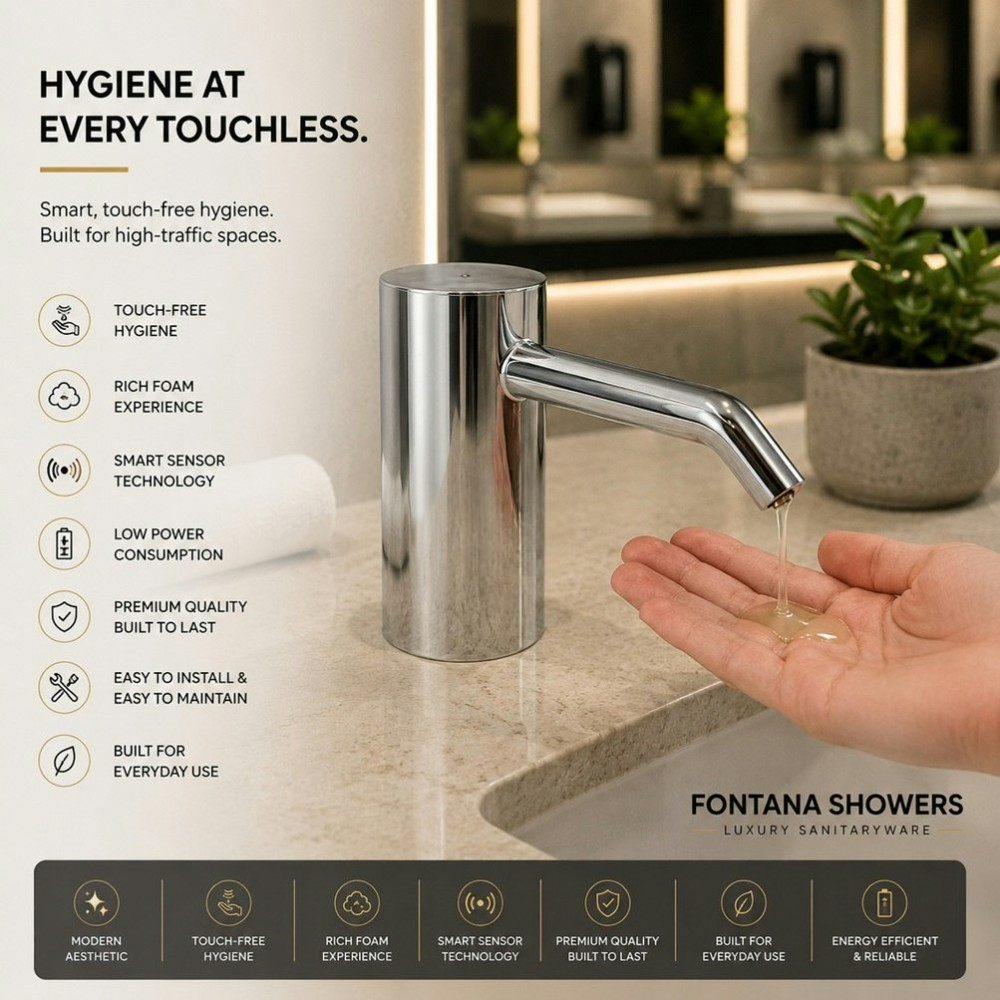
Countertop soap residue is one of the most common maintenance challenges in commercial restrooms. Excess soap accumulation around sinks not only affects restroom appearance but also increases cleaning requirements, creates slip hazards, contributes to user dissatisfaction, and reduces the overall perception of restroom hygiene.
Why Countertop Soap Residue Matters for Facility Managers
In high-traffic facilities such as airports, hotels, healthcare facilities, universities, office buildings, and public restrooms, even small amounts of daily soap waste can quickly become a significant operational issue. Modern touchless soap dispenser systems help reduce countertop residue by improving sensor accuracy, optimizing dispenser placement, and creating a more intuitive handwashing experience.
When soap dispensers, touchless faucets, and sink basins are properly coordinated, facilities can significantly reduce splashing, dripping, and excess soap accumulation while improving restroom cleanliness and user satisfaction.
What Causes Soap Residue Around Commercial Sinks?
Several factors contribute to soap buildup on countertops. Understanding these causes helps facility managers improve restroom cleanliness and reduce operational costs.
Poor Dispenser Placement
Dispensers positioned too far from the faucet or at incorrect heights increase dripping and splashing.
Excess Soap Output
Over-dispensing creates more product than needed, leading to waste and countertop residue.
Inaccurate Sensor Activation
Multiple dispensing cycles from poor sensor calibration increase soap accumulation.
Incorrect Sink Alignment
Soap splashes on countertops when dispensers are not aligned with the sink basin.
User Positioning Issues
Missed soap collection occurs when users cannot find the correct hand position.
High-Traffic Restroom Use
Increased maintenance frequency needed to manage soap buildup from continuous use.
Best Practices for Reducing Countertop Soap Residue
Optimize Soap Dispenser Placement
Soap dispensers should be positioned so users naturally place their hands beneath the dispensing point without reaching awkwardly across the sink.
Coordinate Dispensers with Faucets
Touchless soap dispensers and touchless faucets should work together as a complete handwashing station. Proper spacing reduces dripping and improves user flow.
Adjust Dispensing Volumes
Many facilities dispense more soap than necessary. Proper calibration helps reduce waste and improve countertop cleanliness.
Improve Sensor Accuracy
Reliable sensor activation prevents accidental double dispensing and unnecessary soap discharge.
Select Commercial-Grade Dispensers
High-quality touchless dispensers typically provide more consistent soap output and fewer maintenance issues.
Implement Preventive Maintenance
Regular cleaning of nozzles and sensors prevents clogs and ensures consistent dispensing.
Facility Management Benefits of Reducing Soap Residue
Reducing countertop soap residue offers measurable benefits for facility teams across all commercial environments.
Less Daily Cleaning
Reduced housekeeping time and labor costs.
Lower Soap Consumption
20-40% reduction in product usage.
Improved Restroom Appearance
Cleaner counters enhance facility perception.
Fewer User Complaints
Higher satisfaction from cleaner restrooms.
Reduced Maintenance Labor
Less time spent on countertop cleaning.
Better Hygiene Perception
Cleaner restrooms encourage proper handwashing.
Commercial Facilities That Benefit Most from Cleaner Countertops
Airports need clean restrooms for thousands of daily travelers. Healthcare facilities require spotless environments for infection control. Hotels depend on guest satisfaction and positive reviews. Universities manage high student traffic. Office buildings focus on employee experience. Each facility type benefits from reduced countertop residue and improved restroom cleanliness.
Touchless Soap Dispensers vs Manual Soap Dispensers for Countertop Cleanliness
| Feature | Touchless Soap Dispenser | Manual Soap Dispenser |
|---|---|---|
| Countertop Cleanliness | Better – controlled dispensing | Moderate – user dependent |
| Soap Waste | Lower – pre-measured doses | Higher – overuse common |
| Hygiene | Excellent – no contact required | Standard – handles touched by all |
| User Experience | Better – modern and convenient | Standard – traditional operation |
| Maintenance Efficiency | Higher – predictable refills | Moderate – inconsistent consumption |
Related Commercial Restroom Resources
Explore Commercial Touchless Soap Dispensers
Discover touchless soap dispensers engineered for airports, healthcare facilities, hospitality projects, office buildings, universities, and public restrooms. Compare sensor technologies, maintenance-friendly designs, high-capacity reservoirs, and coordinated handwashing station solutions designed to reduce countertop residue and improve restroom performance.
View Complete Commercial Soap Dispenser CollectionFrequently Asked Questions About Countertop Soap Residue
Poor dispenser placement, inaccurate sensor activation, excessive soap output, and poor sink coordination are the most common causes. Users may also miss the dispensing point if the sensor detection zone is not properly aligned.
Yes. Properly installed touchless dispensers help deliver controlled soap volumes while reducing accidental dispensing. Facilities typically see 30-50% reduction in soap waste and significantly cleaner countertops after upgrading to commercial touchless systems.
Using commercial-grade touchless dispensers, maintaining sensor accuracy, optimizing dispenser placement, and implementing regular cleaning schedules can significantly reduce waste. Adjustable dosage controls allow precise calibration for each facility.
The dispenser should be positioned 4-6 inches from the faucet spout, 6-8 inches above the counter, with the nozzle angled 45 degrees downward. This placement creates natural hand movement between soap and water and minimizes splashing.
Yes. They help reduce contact points, improve hygiene, and minimize soap accumulation around sinks. Cleaner restrooms enhance user satisfaction and reduce housekeeping labor costs.
Nozzles should be cleaned weekly in high-traffic facilities to prevent dried soap residue buildup that can cause clogs and dripping. Use warm water and a soft cloth – avoid abrasive cleaners that can damage the nozzle.
Follow manufacturer viscosity recommendations. Using incompatible soap can cause pump failure, clogs, and increased residue. Commercial-grade soaps with consistent viscosity perform best in automatic dispensers.
Proper placement ensures soap lands directly in users’ hands rather than on the counter. Poor placement causes missed soap collection, splashing, and increased cleaning requirements.
Ready to Reduce Countertop Soap Residue in Your Commercial Restrooms?
Contact Fontana’s commercial specification team for product samples, BIM support, and technical resources.
Explore Commercial Soap DispensersFacility Management Issues from Poor Soap Dispenser Performance
When automatic soap dispensers fail, facility teams face messy counters, restroom complaints, refill inefficiency, hygiene gaps, and repeated maintenance calls.
Automatic Soap Dispensers for Pump Failure Issues
Helps facility managers avoid clogged pumps, uneven portions, and unreliable soap delivery.
Automatic Hand Soap Dispenser for Refill Frequency Issues
Supports facilities dealing with short refill cycles, low capacity, and inconsistent handwashing support.
Automatic Soap Dispenser for Reliability Issues
Helps reduce daily service interruptions, inconsistent activation, and public restroom hygiene complaints.
Automatic Soap Dispensers for Maintenance Issues
Useful for comparing dispensers around capacity, durability, pump control, and facility maintenance needs.
Oil Rubbed Bronze Auto Soap Dispenser for Finish Issues
Helps facility teams solve decorative finish matching, replacement consistency, and restroom design issues.
Vessel Sink Soap Dispenser Compatibility Issues
Supports facility planning where vessel sinks create dispenser height, reach, and installation challenges.
Cintas Auto Soap Instructions for Setup Issues
Helps maintenance teams resolve dispenser setup errors, activation confusion, and service procedure problems.
Automatic Soap Dispensers: Facility Management Pros and Cons
Reviews operational pros and cons around hygiene, cost, refills, maintenance, and dispenser reliability.
Commonly Asked Questions
Lifecycle Impact, Environmental Break-Even & MultiFeed Standards
AEC guidance for whole-system environmental assessment, lifecycle comparison, usage-based break-even analysis, Environmental Product Declarations and performance-based classification of commercial centralized soap-distribution infrastructure.
Does reduced packaging offset the environmental impact of tubing, pumps, electronics, and centralized equipment?
Potentially; packaging reductions can offset added equipment impacts, but only a project-specific life-cycle assessment can determine net environmental performance.
What is the complete cradle-to-grave lifecycle assessment of a multi-feed system versus conventional dispensers?
No universal result exists; compare materials, manufacturing, transport, energy, soap packaging, maintenance, replacements, and end-of-life impacts over equal service lives.
At what annual restroom usage does centralized soap distribution achieve an environmental break-even point?
Break-even usage is site-specific; calculate annual demand where avoided cartridge impacts exceed pumps, tubing, electronics, servicing, and replacement impacts.
Could standardized Environmental Product Declarations be developed specifically for commercial soap-dispensing infrastructure?
Yes; standardized EPDs could compare declared units, materials, manufacturing, energy, maintenance, packaging, replacement, and end-of-life impacts using consistent PCRs.
What independent performance standard should ultimately define when a system can legitimately be classified as a commercial “multi-feed soap dispenser system”?
No dedicated standard currently defines it; classification should require one reservoir supplying multiple outlets, controlled dosing, backflow protection, and serviceability.

