
Commercial Touchless Faucet Standards & Compliance Guide
A professional specification and compliance reference for architects, plumbing and MEP engineers, contractors, facility managers, procurement teams, healthcare planners, hospitality designers, and owners evaluating commercial sensor faucets, automatic soap dispensers, and coordinated touchless washroom systems.
The central rule of this guide is simple: never assume that a product family, finish, or similar-looking model carries the same certification or project approval as another model. Standards, listings, accessibility, flow requirements, electrical conditions, plumbing codes, and local approvals must be verified for the exact product and project jurisdiction.
Guide Navigation
The Commercial Touchless Faucet Compliance Map
No single standard answers every specification question. A compliant commercial installation usually sits at the intersection of accessibility, plumbing-product standards, water-contact requirements, water efficiency, building/plumbing codes, electrical requirements, owner standards, and local authority review.
ADA / U.S. Access Board
Lavatories, sinks, faucet controls, operable parts, reach, knee/toe clearance, mounting height, and accessible use.
Official lavatory guidanceASME A112.18.1 / CSA B125.1
Core plumbing-supply-fitting standard covering lavatory supply fittings, metering/self-closing fittings, and related performance requirements.
ASME standard pageNSF/ANSI/CAN 61
Health-effects criteria for drinking-water system components. Certification must be verified for the exact listed product/model.
NSF listingsNSF/ANSI/CAN 372
Standardized methodology for verifying lead-content compliance. It addresses lead content, not every other faucet performance requirement.
NSF lead-content listingsEPA WaterSense
Useful efficiency guidance, but public and private lavatory faucet categories must not be confused. Verify current program scope and exact product eligibility.
EPA bathroom faucetsIPC / UPC / AHJ
Adopted plumbing and building codes, amendments, fixture requirements, local rules, and the authority having jurisdiction ultimately shape project compliance.
ICC
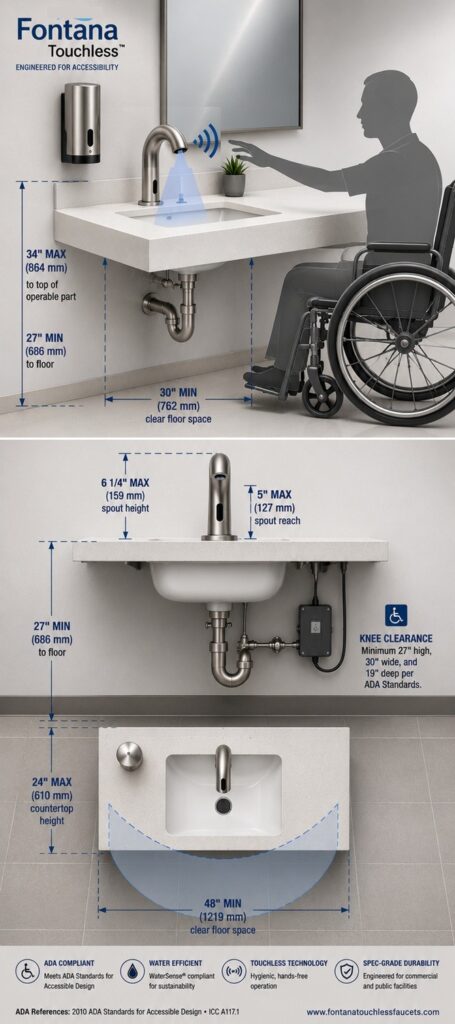
ADA: The Faucet Is Only One Part of an Accessible Lavatory
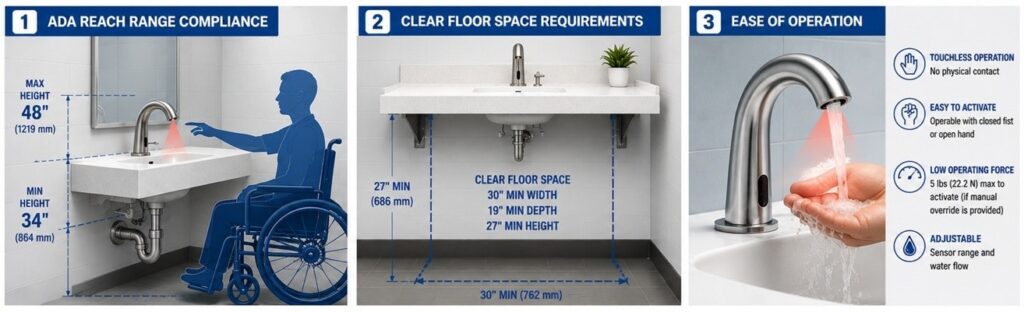
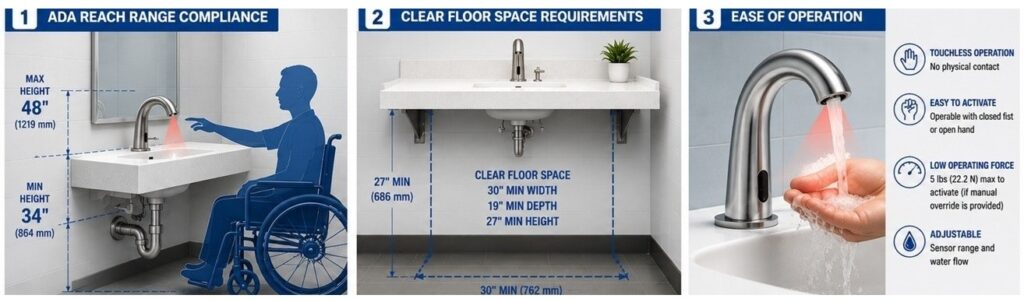
For accessible commercial restrooms, faucet selection must be coordinated with the lavatory, counter, clear floor space, knee and toe clearance, reach, exposed piping, and operable-part requirements. Under the U.S. Access Board guidance for §606, faucet controls must comply with §309.
Manual controls generally need one-hand operation without tight grasping, pinching, or twisting of the wrist and no more than 5 lbf of force. The Access Board also notes that motion-activated touch-free faucets and dispensers can accommodate a broader range of users, and the 10-second minimum for hand-operated metering faucets does not apply to motion-activated controls.

Flow Rate, Water Efficiency & WaterSense
Commercial public lavatory faucets and private bathroom faucets are not interchangeable categories for efficiency labeling. The project team should distinguish code requirements, owner efficiency goals, and WaterSense eligibility.
Public Lavatories
EPA currently states that public lavatory faucets typically installed in non-private toilet facilities should have a flow rate of 0.5 gpm or less to be considered efficient and meet plumbing-code requirements. Verify the adopted code and project criteria.
Private Lavatories
EPA’s WaterSense bathroom-faucet program addresses private lavatory faucets and accessories, with labeled products using a maximum of 1.5 gpm under the existing specification. EPA also notes that specification revision work is ongoing.
WaterSense for commercial facilities
EPA’s WaterSense at Work program provides best-management practices for commercial and institutional facilities, including operation, maintenance, retrofit, replacement, and savings analysis.
EPA WaterSense at Work
ASME A112.18.1 / CSA B125.1
ASME currently lists the 2024 edition of ASME A112.18.1/CSA B125.1 for plumbing supply fittings. Its scope includes kitchen, sink and lavatory supply fittings as well as metering and self-closing supply fittings.
For specification work, the important distinction is between referencing a standard and proving that an exact product is tested/listed/certified as required. The latter should be documented in the submittal package.
- Record the exact standard designation and edition required by the project.
- Request certification/listing documentation where required.
- Confirm the model number on the certificate matches the scheduled product.
- Check whether accessories or alternate configurations affect the listing.
- Do not infer compliance from appearance, brand family, or a similar SKU.
NSF/ANSI/CAN 61 & NSF/ANSI/CAN 372
These two references are often mentioned together, but they address different issues. Treat them as separate verification steps.
NSF/ANSI/CAN 61 — Health Effects
Addresses health-effects criteria for drinking-water system components. NSF’s official listings identify specific certified products and, where relevant, limitations or water-contact conditions.
Search NSF 61 ListingsNSF/ANSI/CAN 372 — Lead Content
Provides a standardized method for determining and verifying lead-content compliance. NSF explains that the standard addresses lead content specifically and commonly works alongside other health-effects requirements.
Search NSF 372 ListingsIPC, UPC, Building Codes & the Authority Having Jurisdiction
National model codes are only part of the compliance path. The controlling requirement is typically the code edition adopted by the project jurisdiction, including local amendments and interpretations.
Identify Jurisdiction
Determine the city/state/agency and project type before assuming a code edition.
Identify Adopted Codes
Confirm building, plumbing, accessibility, energy/electrical, health, and owner requirements.
Map Product Evidence
Match each requirement to current product data, listing, certificate, installation instruction, or engineered detail.
Resolve Exceptions
Document local amendments, alternates, accessibility interpretations, and AHJ decisions before procurement.

Automatic Soap Dispensers: Accessibility, Hygiene & System Coordination
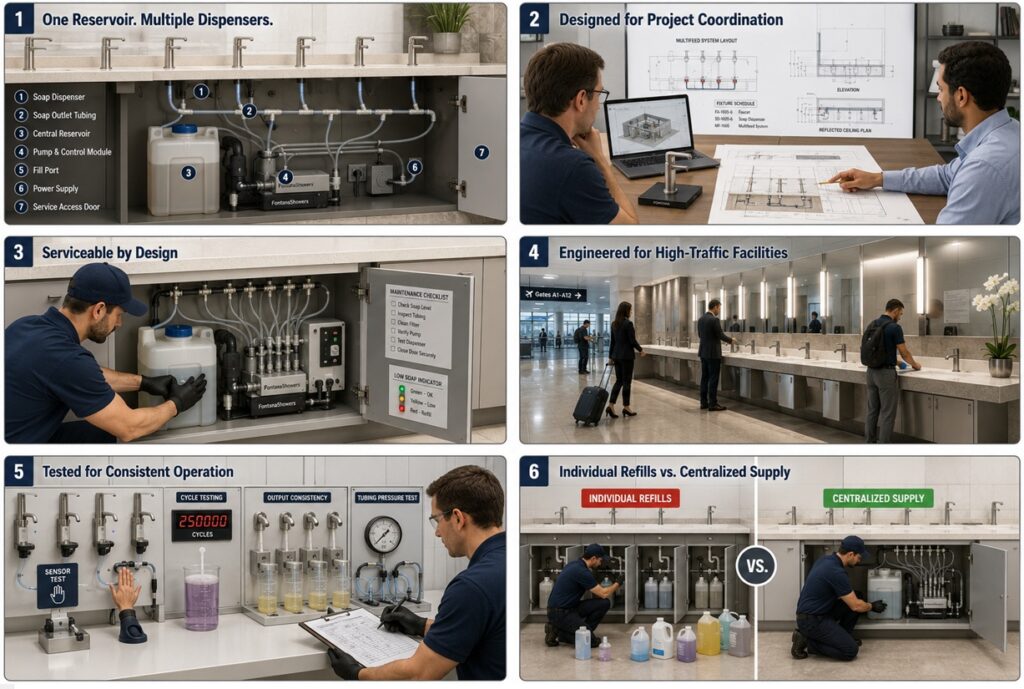
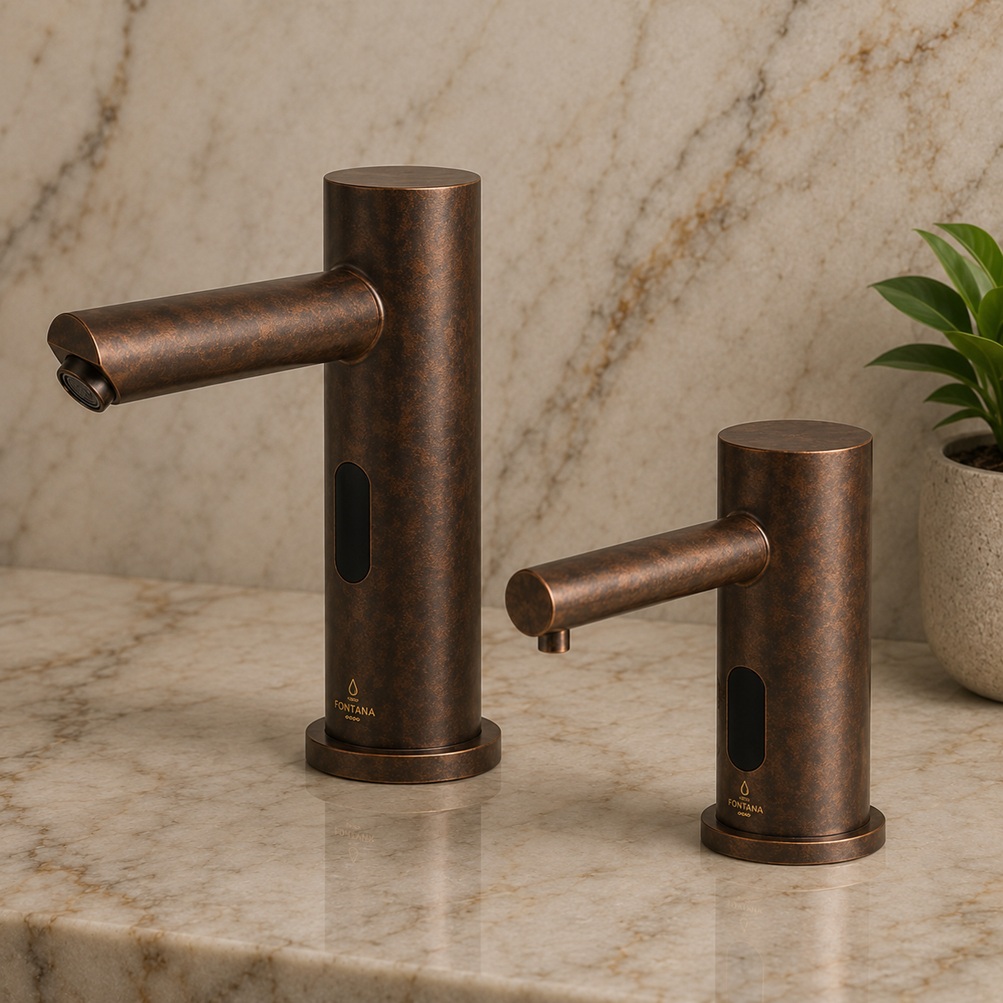
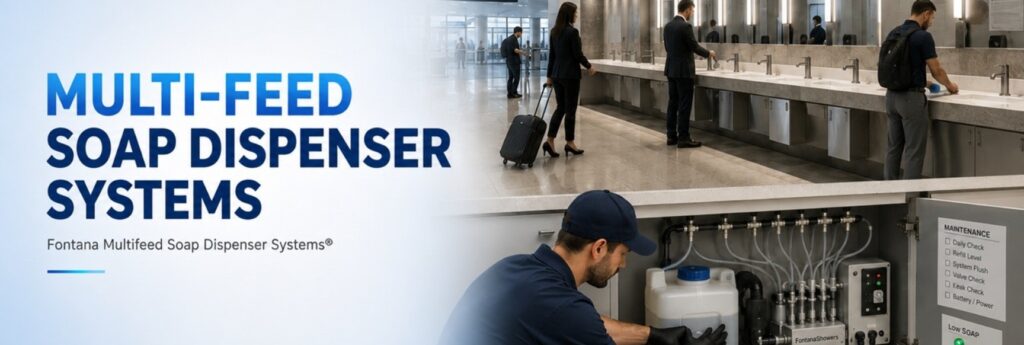
Soap dispensers may not be plumbing supply fittings, but they are part of the accessible handwashing station and should be reviewed for reach, activation, refill strategy, dosage, service access, hygiene protocol, and alignment with the faucet and basin.

Accessibility and handwashing references
The U.S. Access Board notes that soap dispensers and other manually operated elements must satisfy applicable operable-part and reach requirements. WELL also includes handwashing and contamination-reduction concepts in its handwashing feature.
U.S. Access Board • WELL handwashing guidance
Battery, AC/DC & Hybrid Power Must Be Specified—Not Assumed
Touchless faucets introduce power and control components that manual faucets do not. Project documents should identify the approved power strategy, voltage, transformer/control location, access, wiring or battery service requirements, sensor/controller relationship, and any required electrical coordination.
Electrical requirements vary by product and jurisdiction. Coordinate with the project electrical engineer and current manufacturer instructions.
BIM, CAD, Submittals & Digital Specification Data
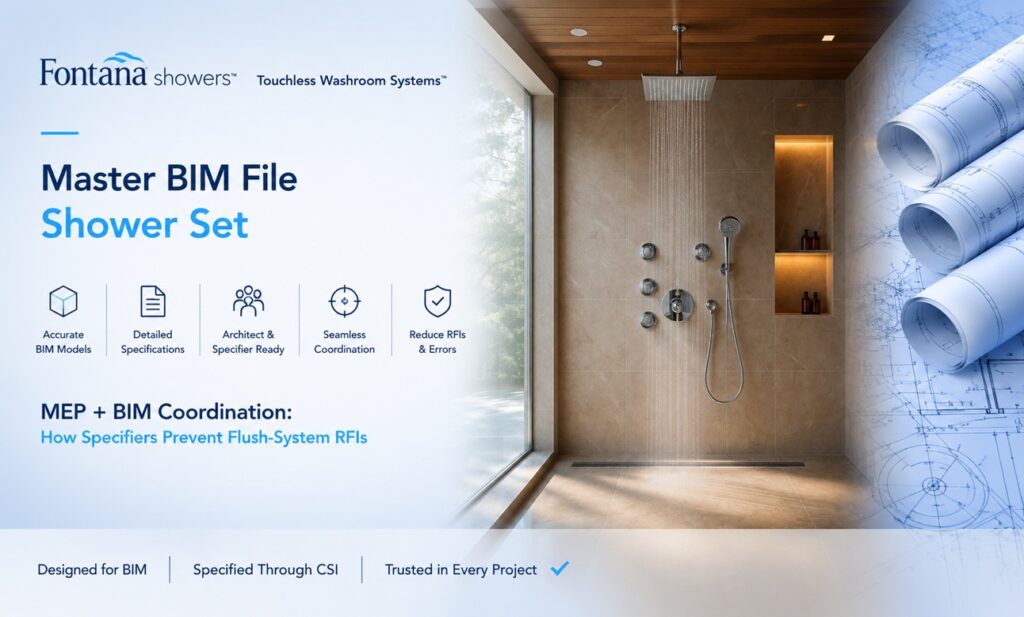
A BIM object is useful only when its geometry and metadata match the product actually being specified. Commercial fixture coordination should connect the design model to the current product data and installation documents.

| Submittal Item | What to Verify | Why It Matters |
|---|---|---|
| Product Data | Exact model, finish, dimensions, spout reach, flow, power, mixing configuration | Prevents family-level data from being substituted for the scheduled product. |
| Certification Evidence | Listing/certificate name, model number, standard, current status | Supports compliance review without relying on marketing language. |
| Installation Instructions | Hole size, deck thickness, supply, valve/control location, electrical needs, service zones | Allows architectural, plumbing, electrical, millwork, and countertop coordination. |
| BIM/CAD | Geometry, connectors, clearance, metadata, model number, revision | Reduces coordination errors and helps maintain model/spec consistency. |
| O&M Data | Batteries, filters, solenoid, sensor, cleaning, troubleshooting, parts | Supports facility handover and lifecycle maintainability. |
Compliance Does Not End at Product Approval
A correctly specified sensor faucet can still perform poorly if installation geometry, power, pressure, sensor aiming, reflective conditions, stream landing location, or commissioning is wrong. Final field verification should confirm both code-related conditions and actual user performance.
- Confirm faucet and lavatory heights, clearances, reach, and accessible approach.
- Confirm stream lands inside the intended basin zone without excessive splash.
- Confirm detection begins and ends predictably for intended hand positions.
- Check nuisance activation from reflections, pass-by traffic, cleaning activity, or adjacent sensors.
- Verify automatic shutoff and any adjustable run-time settings.
- Confirm flow, temperature/mixing, pressure, supply valves, filters, and leaks.
- Verify soap dosage, activation, refill system, and dispenser-to-basin relationship.
- Record final settings and deliver O&M information to facilities.

Architect & MEP Commercial Touchless Faucet Specification Checklist
Use this as a project coordination framework. It is not a substitute for the adopted code, project specification, professional design responsibility, AHJ requirements, or manufacturer instructions.
| Specification Category | Minimum Project Question | Evidence / Coordination |
|---|---|---|
| Application | Public, employee, healthcare, hospitality, stadium, airport, education, government, or other? | Owner criteria + traffic/use profile |
| Accessibility | Does the complete lavatory station satisfy applicable accessible-use requirements? | Plans/elevations + ADA/ABA/local accessibility review |
| Flow Rate | What maximum and minimum performance is required? | Product data + adopted plumbing code + owner efficiency target |
| Product Standard | What plumbing-supply-fitting standard must be met? | Exact-model certificate/listing where required |
| Water Contact / Lead | Are NSF 61 / 372 or equivalent requirements applicable? | Exact-model current third-party listing |
| Power | Battery, AC/DC, hybrid? Where are controller/transformer/battery components? | Electrical + plumbing coordination drawings |
| Sensing | What is the detection zone and adjustment/commissioning process? | Manufacturer installation and commissioning data |
| Valve / Mixing | Where are solenoid, mixing valve, checks, filters, and stops? | Plumbing detail + accessible service zone |
| Basin Compatibility | Does spout reach and stream position work with actual basin geometry? | Coordinated dimensions / mockup where warranted |
| Soap | Is dispenser accessible, aligned, refillable, and coordinated with hand movement? | Elevation + refill/service plan |
| Finish | Does exact finish designation match all scheduled components? | Finish sample / approved product data |
| Maintenance | Can staff access batteries, filters, solenoids, controls, and soap reservoirs? | O&M + access review |
| BIM / CAD | Does digital geometry match the scheduled SKU? | Current manufacturer BIM/CAD + model audit |
| Commissioning | Who verifies sensor, flow, splash, soap, shutoff, and final settings? | Commissioning checklist + owner handover |
High-Traffic, Healthcare, Hospitality & Institutional Applications
Compliance is the baseline. Large commercial projects also need operational resilience: predictable sensing, durable finishes, accessible service zones, rapid maintenance, spare-parts planning, and repeatable standards across many wash stations.

Airports, Stadiums & Transit
Prioritize repeated-use durability, user throughput, nuisance-activation control, water use, maintenance access, and rapid recovery from service events.

Healthcare
Coordinate accessibility, hygiene workflow, cleanability, reliable activation, soap delivery, maintenance procedures, and project-specific infection-control requirements.

Luxury Hospitality & Corporate
Combine code compliance with finish coordination, guest/user experience, acoustic behavior, maintenance access, fixture consistency, and lifecycle standards.
Primary Official Standards & Compliance Sources
For compliance decisions, start with first-party standards organizations, government accessibility resources, adopted codes, official certification listings, and current manufacturer documentation.
Commercial Touchless Faucet Compliance FAQ
Short answers to the specification questions most likely to cause confusion during design, submittal, procurement, or installation.
Does a touchless faucet automatically make a restroom ADA compliant?
No. Motion activation can improve usability, but ADA compliance applies to the complete accessible lavatory condition—including clear floor space, knee/toe clearance, height, reach, operable elements, exposed pipes, and other applicable requirements.
Is every 0.5 gpm commercial faucet WaterSense labeled?
No. EPA distinguishes public-lavatory efficiency from its WaterSense labeling program for private lavatory faucets. Verify current program scope and the exact product’s eligibility/listing rather than treating flow rate alone as a WaterSense label.
What is ASME A112.18.1/CSA B125.1 used for?
It is a plumbing supply fittings standard that covers categories including lavatory supply fittings and metering/self-closing supply fittings. Project specifications should identify the required edition and evidence of conformity.
Are NSF/ANSI/CAN 61 and 372 the same thing?
No. NSF 61 addresses health-effects criteria for drinking-water system components; NSF 372 addresses lead content methodology. Verify the exact model in the applicable official listing.
Who decides which plumbing code applies?
The project jurisdiction adopts and enforces applicable codes, often with amendments. Designers should confirm the authority having jurisdiction, adopted editions, project type, and owner requirements before finalizing specifications.
Should sensor range be written into the specification?
The specification should address required sensing behavior and adjustment/commissioning expectations. Exact range values should be based on current product documentation and coordinated with basin geometry, finishes, mirrors, lighting, and user approach.
What should be included in the touchless faucet submittal?
At minimum: exact model/finish, dimensional data, flow, power, installation instructions, valve/mixing details, relevant current certifications/listings, BIM/CAD where required, maintenance information, and accessories.
Why is commissioning important for touchless faucets?
Because final field conditions can affect sensing and user performance. Commissioning verifies activation, shutoff, flow, splash, temperature, soap coordination, power, leaks, service access, and final settings before turnover.
Complete Standards, Compliance & Professional Reference Directory
This directory preserves the broader standards, professional, design, engineering, facility, hospitality, research, and specification sources used across our commercial-restroom research. Inclusion is for research and educational reference only and does not imply endorsement, certification, affiliation, partnership, or project collaboration.
Water Efficiency, Codes & Compliance
Water conservation, plumbing codes, product standards, certification bodies, and public-sector reference points.
Healthcare, Hygiene & Accessibility
Handwashing, infection control, healthcare planning, accessibility, and facility hygiene resources.
Architecture, Design Media & Education
Architecture institutes, design publications, awards, schools, and professional design communities.
Specification, BIM & Design Technology
Product specification libraries, BIM platforms, CAD references, and design technology resources.
AEC Firms & Engineering Organizations
Major architecture, engineering, construction, and technical professional organizations referenced by project teams.
Engineering Media, Research & Reference
Engineering publications, research platforms, technical references, and scholarly discovery sources.
Facility Management & Commercial Real Estate
Facility management, workplace, building operations, CRE services, and maintenance software resources.
Construction & Interior Design
Construction networks, contractor media, interior design organizations, and workplace design references.
Hospitality, Procurement & Hotel Brands
Hotel ownership, hospitality design, procurement, supply chain, sustainability, and luxury hotel brand references.
Real Estate, Plumbing, Airports, Green Building & Water
Commercial real estate, plumbing media, aviation facilities, sustainability, water, kitchen/bath, and testing resources.
Design, UX & Creative Communities
Creative industry groups, product design, UX, portfolios, awards, and design-thinking references.
Specify the Exact Commercial Touchless System—Not Just the Category
For active projects, compare the exact faucet, soap dispenser, power architecture, flow rate, mounting condition, finish, certification evidence, BIM/submittal data, and maintenance requirements before procurement.
Educational content only. Verify current codes, listings, certifications, manufacturer instructions, product data, and authority-having-jurisdiction requirements for the exact project and model.
