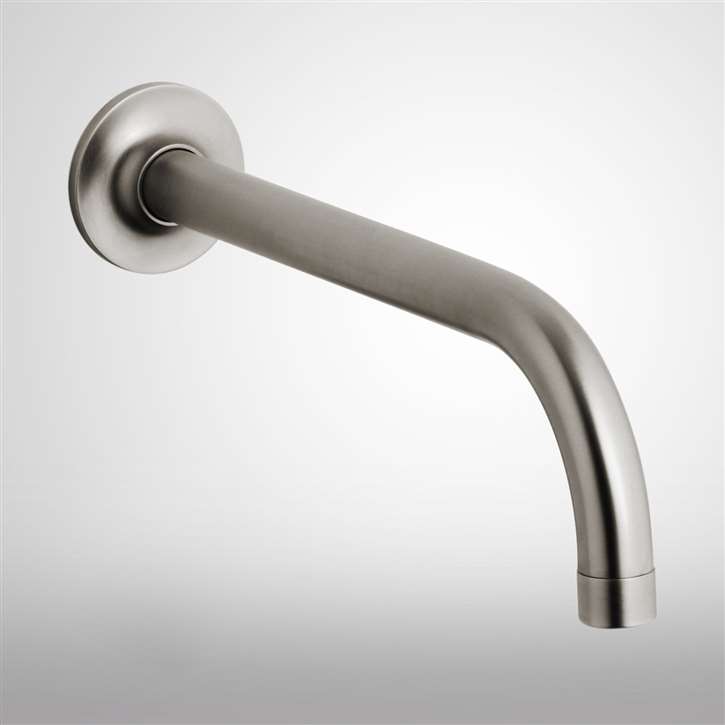
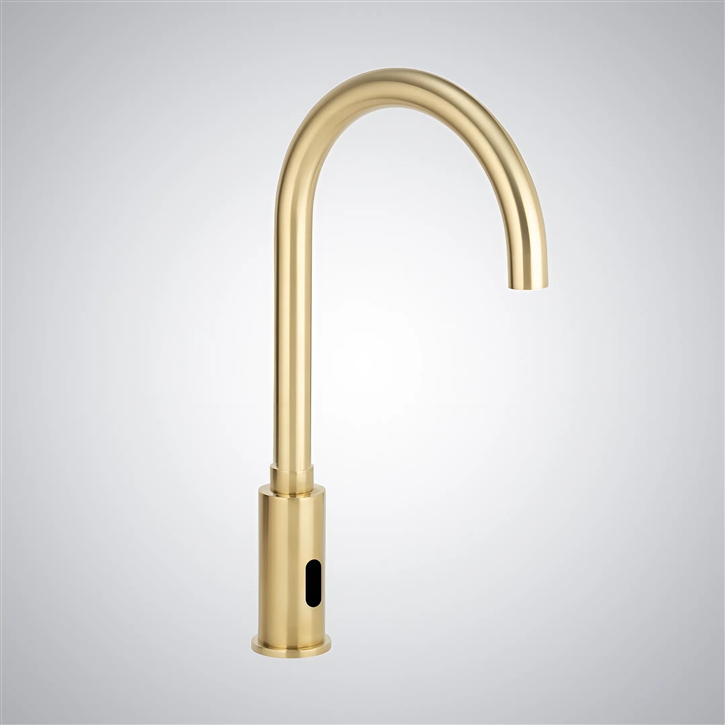
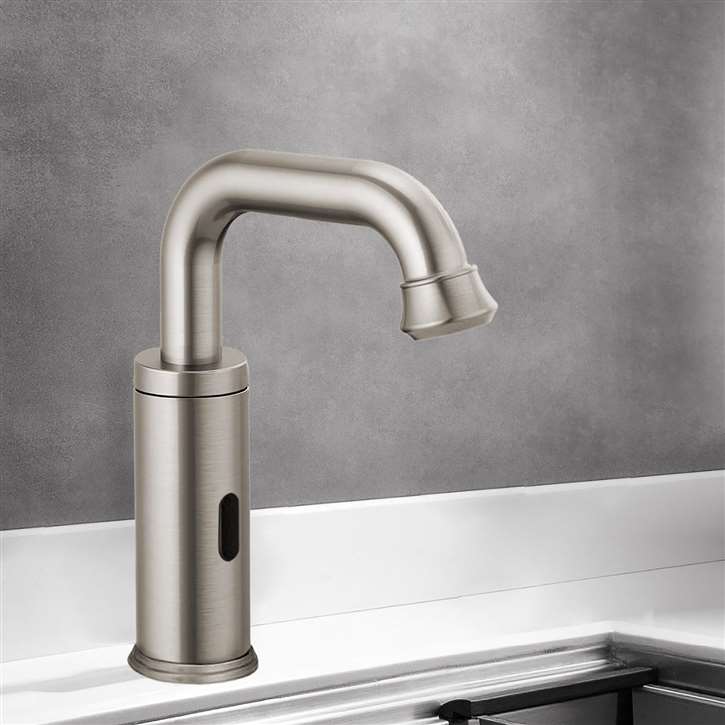
To a user, an automatic faucet appears simple: move a hand beneath the spout and water flows. Behind that interaction, however, the sensing system must decide whether the hand is genuinely inside the intended activation zone while ignoring the sink, drain, backsplash, water stream, nearby fixtures and surrounding movement.
Traditional infrared proximity sensing and Time-of-Flight sensing can both perform this task, but they do not necessarily make the decision in the same way. A conventional reflective infrared system often evaluates the amount of returned optical energy. A direct ToF system measures target distance and can use that distance as an explicit control variable.
That difference sounds small. At the sink, it can change how the activation zone is defined, how reflective surfaces are handled, and how much information the faucet has before opening the valve.
“How much infrared light came back?”
In a simple reflective proximity architecture, the system emits infrared energy and evaluates the reflected signal. When the return crosses a calibrated threshold, the controller may infer that an object is close enough to activate the faucet.
“How far away is the target?”
A ToF sensor measures the travel characteristics of emitted and returned light to calculate target distance. The controller can then determine whether the hand falls inside a defined range window.
The Practical Difference in One Diagram

Why This Matters Around a Sink
The faucet operates within one of the most optically complicated small spaces in a restroom. A typical installation may include polished metal, glazed ceramic, stainless steel, dark matte surfaces, wet countertops, chrome drains and moving water.
These surfaces do not all return infrared energy in the same way. A bright chrome drain can produce a strong reflection, while a dark matte surface can return considerably less light.
With a simple signal-strength approach, the system may need careful adjustment of sensitivity, geometry and threshold values. With direct ranging, distance itself becomes part of the decision.
Traditional IR vs Time-of-Flight at the Faucet
| Engineering Factor | Traditional Reflective IR | Direct ToF | Why It Matters at the Sink |
|---|---|---|---|
| Primary measurement | Returned optical signal / threshold | Measured target distance | Determines what information the controller has before activation. |
| Activation boundary | Sensitivity and reflected-signal threshold | Defined range or distance window | A faucet benefits from a controlled handwashing zone rather than maximum reach. |
| Target reflectivity | Can materially influence returned signal | Distance remains the primary result, though optical quality still matters | Hands, dark finishes and polished surfaces do not behave identically optically. |
| Reflective basin components | May require careful tuning | Distance discrimination can help distinguish target depth | Chrome drains and glossy bowls may sit close to the intended sensing field. |
| Ambient light | Filtering and compensation remain important | Filtering, timing and signal processing remain important | Both are optical systems and must be engineered for actual lighting conditions. |
| Field of view | Emitter/receiver geometry is critical | Optics, ranging algorithm and FoV are critical | The faucet should avoid seeing too much of the surrounding basin environment. |
| Installation validation | Required | Required | Sensor architecture does not eliminate commissioning or basin-specific testing. |
ToF Is Still an Optical Technology
It is inaccurate to describe the comparison simply as “infrared versus ToF.” Many ToF sensors themselves use infrared light. The more useful distinction is between reflected-signal proximity detection and direct distance ranging.
ToF does not make optical design irrelevant. Cover materials, smudging, crosstalk, mounting angle, field of view, strong ambient light and target geometry can still affect performance. The advantage is that the controller receives distance information rather than relying only on return intensity as the indication of proximity.

Surface Reflectivity Is Not an Academic Detail
Consider what happens as a hand moves toward the faucet. The sensor may encounter several potential optical targets before, behind or beside the user’s hand.
Highly reflective metal can produce a strong optical return if it falls inside the sensing field.
Matte or dark materials may return less infrared energy than bright or polished surfaces.
Water films, droplets and splashing can change optical behavior over time.
Skin tone, angle, movement, distance and hand orientation vary continuously during use.
What Changes When Distance Becomes the Control Variable?
Suppose the intended faucet activation region is a narrow zone beneath the spout. With ToF, the controller can use measured distance to determine whether the target is within that zone.
Conceptually, that permits logic such as:
Target enters valid range → activate
Target leaves valid range → close valve
The exact implementation depends on the faucet’s firmware and optical design, but the important point is that distance can become part of the decision itself.
What Time-of-Flight Does Not Automatically Solve
Direct ranging is useful, but it is not immunity from bad engineering or poor installation.
A badly aimed sensor can still view the wrong part of the basin.
Soap film, cleaner residue and mineral deposits can affect the optical path.
A poorly chosen distance window can still include unwanted targets.
Correct sensing cannot compensate for a sticking or leaking solenoid valve.
Electrical faults can create intermittent operation that appears to be a sensor problem.
Real basin geometry and fixture spacing should still be validated after installation.
So Is ToF Better Than Traditional Infrared?
Not universally. Traditional infrared sensing remains mature, economical and effective in many automatic faucet installations.
The advantage of direct ToF becomes particularly relevant when a designer wants the controller to know where the target is, rather than primarily infer presence from how much optical energy returns.
For a faucet operating in a short, tightly constrained zone surrounded by highly variable surfaces, that additional ranging information can be extremely useful.

What a Specifier Should Ask
Sensor type alone should never be treated as a complete performance specification. For either IR or ToF, architects and engineers should ask:
Go Deeper: ToF vs Traditional IR
FontanaShowers’ engineering comparison examines the difference between reflected-light proximity sensing and direct Time-of-Flight ranging, including reflective surfaces, range-window control, environmental considerations and finished-faucet validation.
Read ComparisonFor a broader engineering comparison that also considers mmWave radar, see the complete sensor-technology matrix.
ToF vs IR vs mmWave Sensors for Touchless Faucets →Technical Summary
At first glance, traditional infrared and Time-of-Flight faucets appear to do exactly the same thing: detect a hand and open a valve.
The meaningful engineering distinction lies deeper. Traditional reflective sensing often asks whether enough optical energy has returned to indicate proximity. Direct ToF asks how far away the target is.
At a commercial sink, knowing distance can make the activation zone a measured space rather than merely a reflected-signal threshold.
STMicroelectronics — Time-of-Flight proximity and ranging sensor documentation.
FontanaShowers — ToF vs Traditional IR and commercial touchless faucet sensor-engineering technical series.
Related ToF and Infrared Touchless Faucet Guides