


Commercial Specification
Specifying a commercial automatic soap dispenser requires more than selecting a touchless fixture from a catalog. Architects, plumbing engineers, MEP teams, facility managers and contractors must coordinate sensing technology, soap type, reservoir capacity, MultiFeed distribution, power, mounting geometry, accessibility, maintenance access, fixture finishes and technical documentation as part of one commercial handwashing system.
Bulk Soap vs Sealed Cartridge Automatic Dispensers: 10-Year Cost, Hygiene, Waste, Procurement & Refill Labor
Should a commercial restroom use refillable bulk liquid soap, a centralized MultiFeed reservoir, or manufacturer-specific sealed soap cartridges? The answer affects much more than the price of the dispenser. Soap sourcing, dose, refill labor, contamination controls, packaging, inventory, maintenance, supply-chain flexibility and replacement availability can materially change the total cost of operating hundreds of automatic dispensers over ten years.
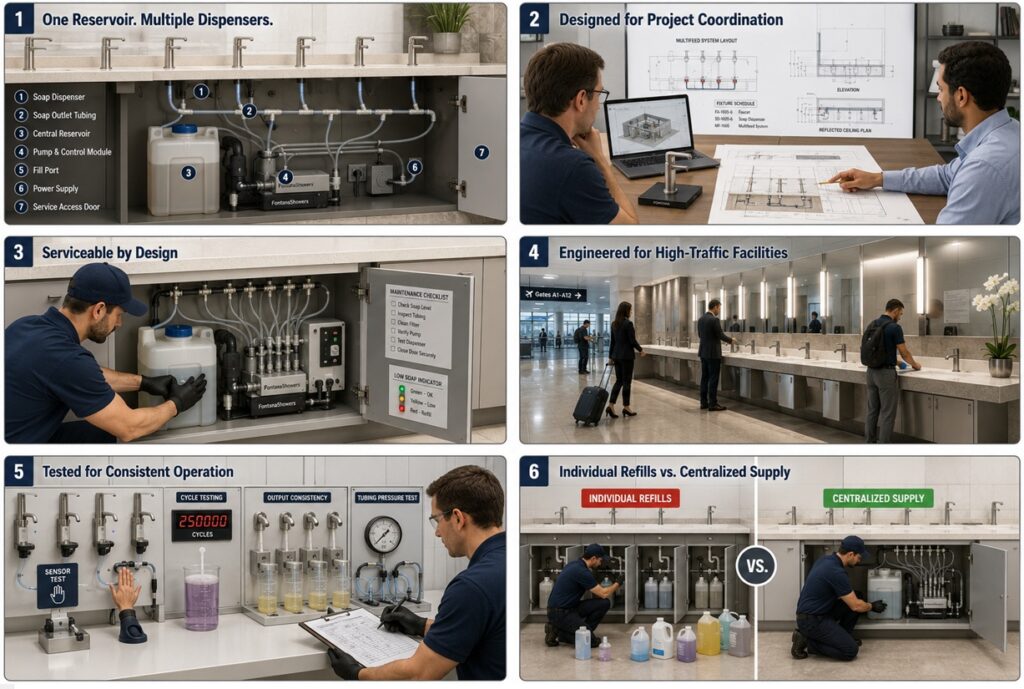
Two Very Different Commercial Soap Supply Strategies
Both approaches can be appropriate. Their benefits simply occur in different parts of the facility operating model.
Bulk Soap vs Sealed Cartridge: Commercial Comparison
| Factor | Open / Bulk Soap | Sealed Cartridge |
|---|---|---|
| Soap Procurement | Potentially broad supplier flexibility | Manufacturer/system-specific refill family |
| Cost Visibility | Usually compared by cost per liter | Usually compared by cost per refill / handwash |
| Refill Hygiene Control | Depends heavily on proper cleaning and refill procedure | Sealed refill simplifies contamination control |
| Packaging | Large bulk containers can reduce units of packaging | Dedicated package for each refill |
| Residual Product | Depends on container/pump design | Some systems are designed for high evacuation |
| Supplier Lock-In | Can be lower where compatible soap is open | Can be higher |
| Soap Compatibility Risk | Facility must control viscosity and chemistry | Pre-engineered refill compatibility |
| Central MultiFeed Potential | Strong | Generally not the same architecture |
| Inventory Simplicity | Can standardize one bulk soap across compatible equipment | Simple when facility standardizes one refill ecosystem |
| Facility Discipline Required | Higher | Lower refill-process variability |

The Fair Metric: Cost per 1,000 Handwashes
Comparing a five-gallon bulk container with a one-liter sealed refill by package price is not meaningful.
Normalize both systems to the same unit:
Dose in mL × Bulk Soap Cost per Liter
Why does that formula work? At 1,000 activations, a 0.8 mL dose consumes 800 mL, or 0.8 liters.
Refill Price ÷ Published Usable Handwashes × 1,000
Then add refill labor, waste handling and service costs to create a full facility comparison.
Illustrative Bulk Soap Cost
Assume compatible bulk soap costs an illustrative $4 per liter. This is an example only, not a market quotation.
| Programmed Dose | Soap Used / 1,000 Activations | Illustrative Cost at $4/L |
|---|---|---|
| 0.5 mL | 0.50 L | $2.00 |
| 0.8 mL | 0.80 L | $3.20 |
| 1.0 mL | 1.00 L | $4.00 |
| 1.2 mL | 1.20 L | $4.80 |
| 1.5 mL | 1.50 L | $6.00 |
At scale, dose can be as important as the underlying soap price.
Sealed Refill Systems Should Be Compared by Published Yield
Rubbermaid Commercial’s current AutoFoam dye- and fragrance-free foam soap refill is a useful manufacturer example.
Its current 1,100 mL refill is rated for up to 2,750 handwashes, while Rubbermaid describes the refill as hygienically sealed and designed to evacuate fully to reduce product waste.
1,100 mL ÷ 2,750 handwashes ≈ 0.4 mL per stated handwash yield
That does not mean every sealed refill from every manufacturer dispenses 0.4 mL. It simply demonstrates why cartridge systems should be compared using their own published refill yield.
Rubbermaid AutoFoam Refills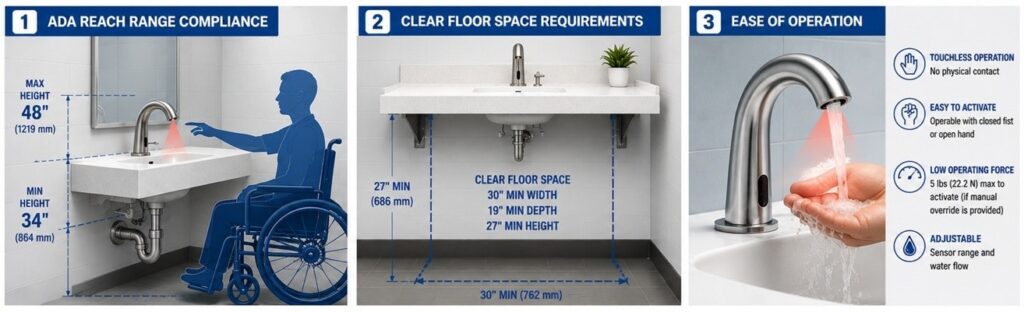
Hygiene: What CDC Actually Says About Refillable Soap
There is an important distinction between a properly maintained refillable system and the unsafe practice of casually adding new soap into an existing, partially empty dispenser.
CDC states that adding liquid soap to partially empty soap dispensers has been associated with outbreaks involving pathogenic bacteria and advises that soap should not simply be added to partially empty dispensers.
WHO guidance similarly states that soap should not be added to a partially empty dispenser and that reusable dispensers should follow recommended cleaning procedures.
Why Sealed Refills Appeal to Healthcare and Controlled Environments
A sealed cartridge reduces the number of variables involved in the refill process.
Rubbermaid explicitly describes current AutoFoam refills as hygienically sealed to reduce potential cross-contamination.
Where Bulk Soap Can Have a Major Procurement Advantage
Compatible bulk systems can give facility purchasing teams considerably more freedom.
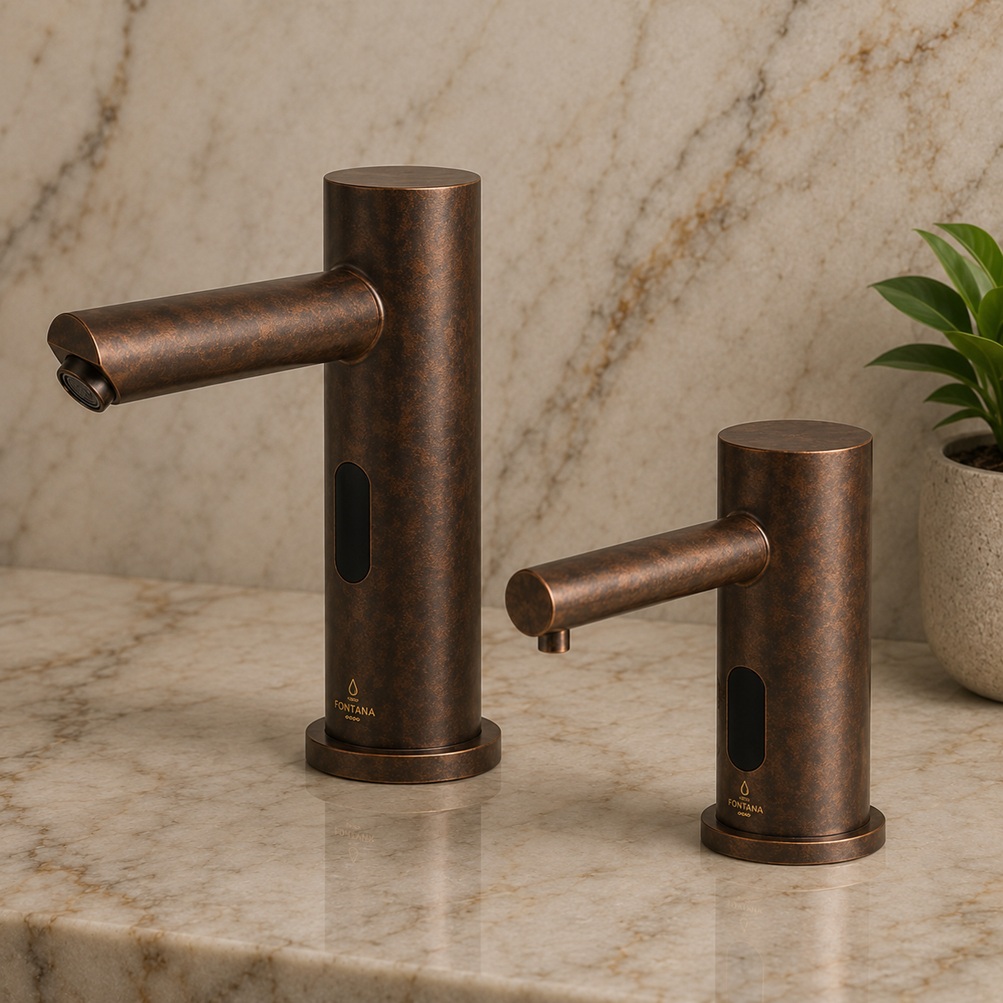
Current Fontana commercial dispenser examples use standard liquid soap and document refillable reservoirs ranging from approximately 800 mL to larger optional containers, while one current commercial dispenser uses a 5-liter soap container.
Fontana 5 L Commercial DispenserThe Tradeoff: Open Soap Requires Better Specification Discipline
Procurement flexibility is useful only if the replacement soap remains compatible with the dispenser.
The facility should verify:
For example, current Fontana specifications for selected automatic commercial dispensers document standard liquid soap, peristaltic pump architecture and adjustable output around 0.5–1.5 mL per use.
Refill Labor: Cartridge Replacement vs Bulk Replenishment
Cartridge and bulk systems impose different labor patterns.
| Service Task | Bulk Individual Reservoir | Sealed Cartridge | Central MultiFeed |
|---|---|---|---|
| Locate Supply | Bulk container | Correct cartridge SKU | Bulk container |
| Open Fixture | Usually | Usually | Central location |
| Remove Old Container | Not always | Yes | Not at every head |
| Pour Product | Usually | No | At central reservoir |
| Potential Spill Handling | Higher | Lower | Concentrated at service point |
| Dispose Refill Package | Bulk container periodically | Each used cartridge | Bulk container periodically |
| Service Each Dispenser | Yes | Yes | Soap refill consolidated |
The labor winner therefore depends heavily on architecture.
A sealed cartridge can be faster than filling an individual reservoir, but a central MultiFeed system can potentially eliminate the need to replenish individual soap containers at every sink.
MultiFeed Changes the Bulk-Soap Equation
Comparing one refillable dispenser against one cartridge dispenser misses the main economic advantage of centralized bulk architecture.
Fontana’s current MultiFeed engineering guidance describes a central reservoir, pump assembly, distribution manifold and dedicated feed lines supplying multiple compatible automatic soap dispensers.
The stated operational purpose is to consolidate refilling, improve supply visibility and reduce the number of separate under-counter soap containers that must be serviced.
Packaging Waste: Avoid Oversimplified Claims
It is tempting to say that bulk soap always creates less waste than sealed cartridges. The real answer depends on packaging design, refill size, evacuation rate, shipping configuration and recycling options.
Some cartridge manufacturers actively engineer around those disadvantages. Rubbermaid, for example, currently states that selected AutoFoam refills are designed to evacuate fully and use box-less packaging to reduce packaging waste.
Packaging Comparison Formula
Annual Packaging Weight ÷ Annual Handwashes × 100,000
Purchased Soap Volume − Measured Dispensed Volume
These two measurements allow facilities to compare systems using actual operational data rather than marketing language.

Procurement Lock-In Can Become a 10-Year Cost
A dispenser may remain installed for years. Its soap supply therefore becomes a long-term procurement decision.
Healthcare: Hygiene Procedure May Outweigh Soap Price
In clinical environments, the lowest consumable price is not necessarily the most important criterion.
WHO notes that dispenser design, reliability, adequate product volume and product acceptance all matter in healthcare hand-hygiene systems.
CDC’s instruction against topping off partially empty soap dispensers makes documented refill procedure particularly important.
10-Year Total Cost of Ownership
Equipment + Installation + Soap + Refills + Labor + Batteries/Power + Maintenance + Repairs + Packaging Handling + Inventory
A sealed system can have a higher or lower TCO than a bulk system depending on the project.
Likewise, a bulk system is not automatically less expensive simply because the soap costs less per liter.
Illustrative 1,000,000-Handwash Procurement Model
This example demonstrates the calculation structure without assuming actual market prices.
| Input | Bulk System | Sealed Cartridge System |
|---|---|---|
| Annual Handwashes | 1,000,000 | 1,000,000 |
| Average Soap per Handwash | 0.8 mL example | Use manufacturer’s published yield |
| Annual Soap Requirement | 800 L theoretical | Refills required = 1,000,000 ÷ published yield |
| Consumable Unit Cost | $_____ / L | $_____ / refill |
| Annual Consumable Cost | $_____ | $_____ |
| Annual Refill Labor | $_____ | $_____ |
| Annual Packaging Handling | $_____ | $_____ |
| Annual Maintenance | $_____ | $_____ |
| 10-Year TCO | $_____ | $_____ |
Which Architecture Is Better by Facility Type?
| Facility | Bulk / MultiFeed Case | Sealed Cartridge Case |
|---|---|---|
| Airport | Strong where many heads justify centralized service | Useful where standardized wall systems are preferred |
| Stadium / Arena | Strong for large dispenser banks and event servicing | Can simplify individual refill replacement |
| Hospital Public Restrooms | Possible with strict refill procedures | Sealed refill can simplify hygiene controls |
| Clinical Areas | Follow facility IPC requirements | Often attractive where sealed systems align with IPC policy |
| University | Bulk purchasing and centralized systems may scale well | Useful for standardized wall dispenser fleets |
| Office Tower | Open soap sourcing can support lifecycle procurement | Simple standardized service process |
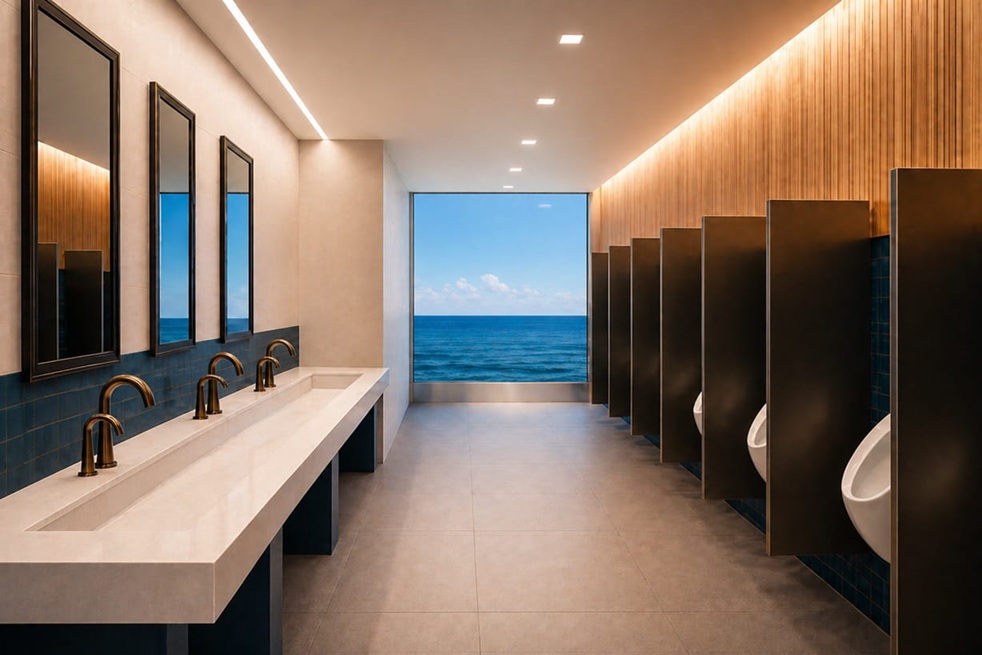
| Luxury Hospitality | Architectural deck-mounted systems can hide soap supply | Wall cartridge may not suit every design aesthetic |
What Architects & Facility Teams Should Specify
Bulk vs Cartridge 10-Year TCO Worksheet
| Cost Input | Bulk / MultiFeed | Sealed Cartridge |
|---|---|---|
| Dispenser acquisition | $________ | $________ |
| Installation | $________ | $________ |
| Annual activations | ________ | ________ |
| Soap dose / refill yield | ________ mL | ________ uses/refill |
| Soap price | $________ / L | $________ / refill |
| Annual soap/refill cost | $________ | $________ |
| Annual refill labor | $________ | $________ |
| Annual PM / cleaning | $________ | $________ |
| Annual packaging handling | $________ | $________ |
| Annual repairs | $________ | $________ |
| Inventory carrying cost | $________ | $________ |
| 10-year consumable cost | $________ | $________ |
| 10-year total ownership cost | $________ | $________ |
Verified Fontana Commercial Soap System Resources
Every Fontana internal destination below was checked before inclusion.
Central reservoir, bulk soap, pumps, manifolds, tubing and commercial service planning.
MultiFeed EngineeringFontana’s current commercial automatic soap-dispenser collection.
Automatic Soap SystemsProduct, system and technical navigation for commercial touchless soap.
Touchless Soap HubCapacity, dose, operating reserve and refill-interval planning.
Refill Frequency GuideIndividual and centralized reservoir planning for intensive-use restrooms.
Reservoir Capacity GuideFontana project, BIM and specification support for commercial design teams.
AEC ResourcesCommercial Automatic Soap Dispenser Research Series
How bulk soap, central reservoirs and distribution networks serve multiple automatic dispensers.
MultiFeed SystemsSize the soap supply according to traffic, dose and desired service interval.
Capacity PlanningCalculate days between service visits using usable capacity and daily consumption.
Refill PlanningCurrent Fontana commercial deck-mounted dispenser documenting a 5-liter soap container.
5 L Commercial SystemCommercial touchless soap product and system resources.
Touchless ResourcesReview current Fontana commercial automatic dispensing platforms.
Commercial DispensersIndependent Hygiene & Sealed-Refill References
Official guidance addressing liquid-soap refill practices and contamination risk.
CDC GuidanceInternational hand-hygiene guidance covering dispenser reliability, product volume and refill procedures.
WHO Hand HygieneManufacturer example of sealed commercial soap refills with published handwash yield.
AutoFoam RefillsBulk Soap vs Cartridge FAQ
Is bulk soap cheaper than sealed cartridges?
It can be, particularly where compatible soap is purchased competitively in larger quantities. But total cost must include dose, refill labor, cleaning, maintenance, waste and inventory rather than soap price alone.
Are sealed cartridges more hygienic?
Sealed refills can reduce product handling and potential contamination during replenishment. However, hygiene also depends on dispenser design, maintenance, staff procedure and correct use.
Does CDC prohibit refillable soap dispensers?
No. CDC specifically warns against adding soap to partially empty dispensers because topping-off practices have been associated with bacterial contamination. Reusable systems should follow appropriate cleaning and refill procedures.
What is proprietary soap?
It is a soap or refill designed for a specific dispenser ecosystem, often in a dedicated cartridge or refill package that is not freely interchangeable with other products.
What is open bulk soap?
It generally refers to compatible soap sourced separately and poured into or supplied through a refillable dispenser system, subject to the manufacturer’s soap-type and viscosity requirements.
Can Fontana commercial dispensers use standard liquid soap?
Yes, selected current Fontana commercial automatic dispenser specifications document standard liquid soap, along with model-specific viscosity, reservoir and dose requirements.
Can bulk soap feed multiple automatic dispensers?
Yes. A properly engineered centralized MultiFeed architecture can distribute compatible soap from a central reservoir to several connected automatic dispensing heads.
Does cartridge packaging always create more waste?
Not necessarily. Packaging intensity should be measured. Some cartridge manufacturers specifically engineer refill evacuation and reduced packaging, while bulk containers can also contain residual product or require disposal.
How should procurement compare soap systems?
Calculate cost per 1,000 usable handwashes and then add refill labor, maintenance, consumable inventory, packaging handling and expected equipment cost over the ownership period.
Which system is best for high-traffic restrooms?
There is no universal winner. Large dispenser banks may favor centralized bulk systems, while facilities emphasizing tightly controlled refill procedures may favor sealed cartridges. The decision should be based on actual traffic, facility protocols, labor and lifecycle cost.
Final Recommendation: Compare Cost per Usable Handwash, Not Package Price
Bulk soap and sealed cartridges solve different facility-management problems.
The strongest large-facility bulk case occurs when many automatic dispensing positions can be consolidated around one professionally planned central supply. Fontana’s current MultiFeed architecture is explicitly designed around that service model.
The strongest sealed-refill case occurs when the facility values controlled soap packaging and predictable refill handling enough to accept a dedicated consumable ecosystem.
That metric forces procurement to evaluate soap, dose, labor, packaging, maintenance and equipment together instead of deciding the entire system from the price printed on one refill container.
Important Questions
Automatic Dosing, Response Speed & User Behavior
AEC guidance for automatic dose optimization, repeat activations, dispenser response speed, acoustic perception and user interaction with centralized commercial soap-distribution systems.
Does a smaller automatic dose cause users to trigger the dispenser twice, eliminating intended soap savings?
Yes; undersized doses may increase repeat activations, offsetting savings. Validate dose settings against measured user behavior and total soap consumption.
Is there an optimal automatic dose that minimizes total consumption without reducing perceived adequacy?
Optimal dose is site-specific; balance measured consumption, repeat activations, hand coverage, soap formulation, and user acceptance during commissioning.
Does dispenser response speed influence whether users attempt a second activation?
Yes; delayed response can prompt repeat gestures or second activations. Fast, consistent detection generally improves confidence and reduces unnecessary retriggering.
Does audible pump operation affect user perception of dispenser quality?
Yes; loud or irregular pump noise can signal poor quality to users, while quiet, consistent operation generally feels more refined.
Do users behave differently when they know the dispensers are supplied from one centralized reservoir?
Usually not; most users respond to outlet performance, not reservoir architecture. Centralization mainly affects maintenance, uptime, and refill logistics.

