

Coordinating Faucets and Soap Dispensers as One Wash Station
When faucets and soap dispensers are specified separately, users may experience inconsistent activation and awkward hand movement. Fontana coordinated systems help create a smoother, cleaner wash station.
Table of Contents
Why Coordinate Faucets and Soap Dispensers as One Wash Station?
In modern commercial restroom design, the handwashing zone should function as a single, intuitive unit — not separate components specified in isolation. When faucets and soap dispensers are coordinated as one wash station, users experience consistent sensor activation, natural hand movement, and seamless transitions between soap and water.
Fontana coordinated systems eliminate the guesswork of mixing different brands, finishes, and sensor technologies. Architects and designers can specify complete wash station solutions where every component shares the same design language, finish consistency, and activation logic — creating professional, hygienic environments that users appreciate.
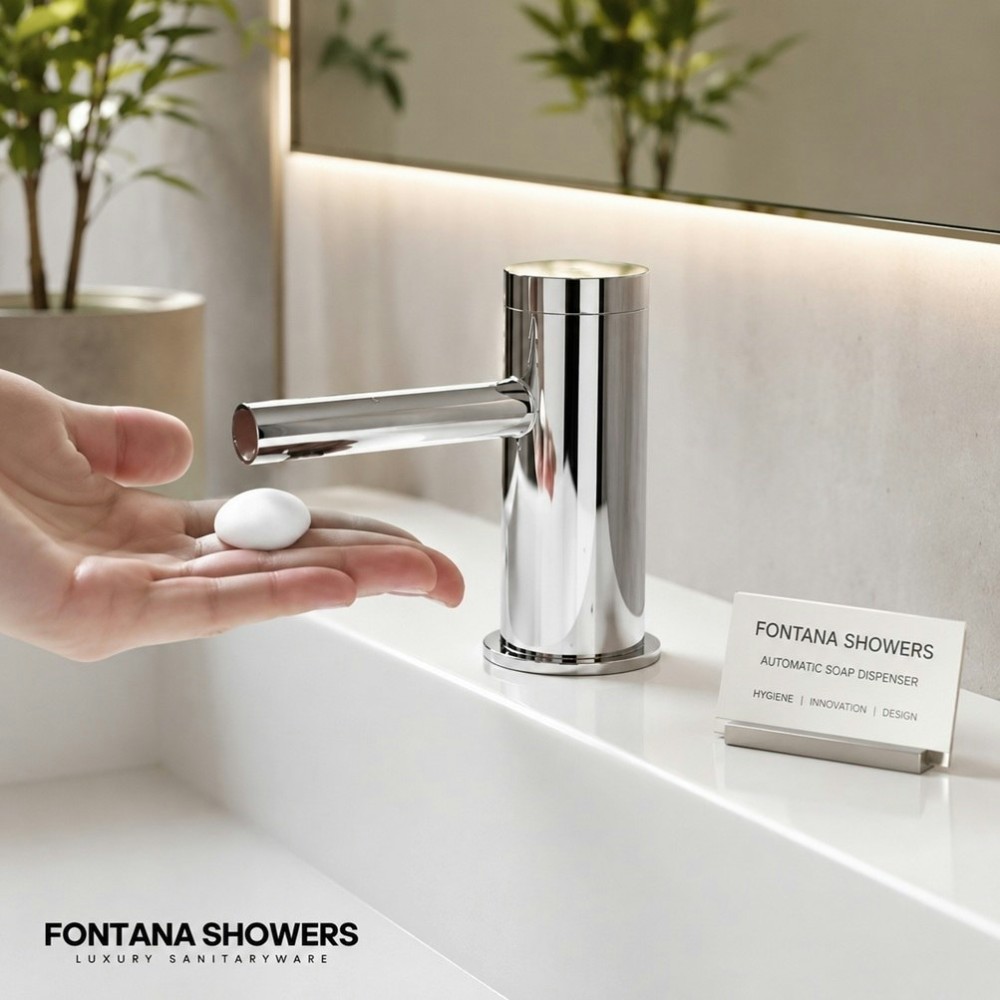
Common Problems When Specifying Faucets and Soap Dispensers Separately
Inconsistent Activation Zones
Different sensor ranges can confuse users when the faucet and soap dispenser activate at different hand positions.
Mismatched Finishes
Different brands may have subtle finish variations that create visual inconsistency across the wash station.
Awkward Hand Movement
Poor placement can force unnatural movement between soap dispensing and water activation.
Mixed Operation Types
A touchless faucet paired with a manual soap dispenser can interrupt an otherwise hands-free workflow.
Different Power Sources
Mixed battery and hardwired systems can increase maintenance complexity across multiple wash stations.
Varying Maintenance Needs
Multiple brands can mean separate service procedures, replacement parts, and maintenance requirements.
Finish Coordination Guide for Wash Stations
Selecting matching finishes across faucets and soap dispensers is essential for a professional wash-station design. Fontana offers coordinated sets in widely specified commercial finishes.
Coordinating faucet and dispenser finishes helps create a visually cohesive installation and reduces obvious color or sheen differences between adjacent fixtures. Finish samples should still be reviewed when exact matching is critical to a project specification.
Benefits of Coordinated Wash Station Systems
Seamless User Experience
Natural movement from soap to water
Visual Consistency
Coordinated finishes and fixture forms
Simplified Specification
Clearer fixture-set coordination
Reduced User Confusion
More consistent sensor interaction
Easier Maintenance
More standardized service planning
Faster Installation
Pre-coordinated components simplify setup
Best Practices for Wash Station Design
Specify Complete Sets
Use coordinated sets where appropriate to support finish consistency and a unified fixture design language.
Optimize Placement
Coordinate faucet and dispenser spacing around basin geometry, splash control, reach, and natural hand movement.
Match Sensor Behavior
Review activation zones and sensing behavior so adjacent fixtures respond predictably without interfering with each other.
Standardize Power
Use consistent power strategies where practical to simplify maintenance, access, and replacement planning.
Coordinate Mounting Heights
Confirm mounting dimensions against the applicable accessibility requirements and project-specific lavatory configuration.
Test Before Specification
Review samples, finish chips, sensor performance, and installation requirements before finalizing project selections.
Professional wash-station design requires attention to the complete handwashing workflow. When faucets and soap dispensers are coordinated as a system, users can move naturally from soap activation to handwashing without unnecessary reaching or searching for sensors. For facility teams, a more standardized fixture strategy can also simplify parts inventory, maintenance procedures, and service planning across multiple restrooms.
Coordinated vs Separate Specification
Coordinated Specification
Supports consistent finish selection, aligned sensor behavior, simpler maintenance planning, and a more unified wash-station appearance.
Separate Specification
Can provide flexibility, but requires closer review of finish compatibility, sensor behavior, mounting, power, service access, and replacement parts.
Frequently Asked Questions About Wash Station Coordination
Common specification questions for architects, designers, contractors, and facility teams.
Ready to Create Coordinated Wash Stations for Your Project?
Explore Fontana’s collection of coordinated faucet and soap dispenser sets across multiple commercial finish and sensor configurations.
View Coordinated Sets →Related Coordinated Touchless Wash-Station Guides




Commonly Asked Questions
Viscosity Measurement, Adaptive Calibration & Dose Prediction
AEC guidance for automatic viscosity measurement, adaptive pump calibration, dose-error analysis, temperature compensation and hydraulic modeling within centralized commercial soap-distribution systems.
Can viscosity be measured automatically during each refill?
Yes; inline viscometers can measure viscosity during refill, provided sampling temperature, calibration, and soap formulation are controlled.
Could pump calibration adjust itself continuously based on measured viscosity?
Yes; closed-loop control can adjust pump speed or valve timing continuously using measured viscosity and verified calibration limits.
How much dose error results from a 10%, 20%, or 50% change in soap viscosity?
No fixed dose error follows from viscosity change; sensitivity depends on pump type, pressure, tubing resistance, and control strategy.
Can temperature compensation maintain identical dosage across seasonal conditions?
Yes; temperature compensation can stabilize dosage if viscosity-temperature behavior is characterized and the controller adjusts pump or valve operation.
What mathematical relationship best predicts dose size from viscosity, pressure, tube diameter, and valve-open time?
For laminar tubing flow, Hagen-Poiseuille scaling links dose to pressure, viscosity, diameter, tube length, and valve-open time.

