


Commercial Specification
Specifying a commercial automatic soap dispenser requires more than selecting a touchless fixture from a catalog. Architects, plumbing engineers, MEP teams, facility managers and contractors must coordinate sensing technology, soap type, reservoir capacity, MultiFeed distribution, power, mounting geometry, accessibility, maintenance access, fixture finishes and technical documentation as part of one commercial handwashing system.
How Much Does a Commercial Automatic Soap Dispenser System Cost? 1 Sink vs 6 vs 12 vs 24 Dispensers
The real cost of a commercial automatic soap dispenser system is not simply the purchase price of the dispenser. Architects, contractors, developers, facility managers and procurement teams should evaluate equipment, installation, electrical requirements, reservoirs, soap, refill labor, maintenance, batteries or power supplies, replacement parts and the expected 10-year operating cost.
This guide provides a project-planning framework for one sink, six sinks, twelve sinks and twenty-four dispensing positions—including individual reservoirs and centralized MultiFeed configurations.

Commercial Soap Dispenser Cost Has Seven Main Components
1 Sink vs 6 vs 12 vs 24: What Changes?
| Project Size | Typical Architecture | Primary Cost Driver | Primary Operational Concern |
|---|---|---|---|
| 1 Sink | Independent dispenser | Fixture + installation | Simple maintenance |
| 6 Sinks | Six individual reservoirs or central feed | Equipment quantity + service strategy | Refill labor |
| 12 Sinks | Individual systems or engineered central architecture | Distribution, capacity and redundancy | Soap supply during peak demand |
| 24 Sinks | Multiple zones / multiple central systems | System architecture + maintenance logistics | Avoiding single-point failure |
Step 1: Calculate Equipment Cost
Number of Dispensing Positions × Net Equipment Cost per Position
For an individual-reservoir system, the equipment package may include the dispenser, sensor electronics, soap reservoir, pump, power supply and mounting hardware.
For a centralized system, the project may instead include dispensing heads, central reservoir, pump assembly, manifold, tubing, power components and system-specific accessories.
Illustrative Equipment Budget Worksheet
Enter the project’s actual quoted equipment price rather than relying on a generic industry average.
| Project | Dispensing Heads | Net Equipment / Head | Central Equipment | Equipment Budget |
|---|---|---|---|---|
| Single Sink | 1 | $________ | — | $________ |
| 6-Sink Restroom | 6 | $________ | $________ | $________ |
| 12-Sink Restroom | 12 | $________ | $________ | $________ |
| 24-Sink Facility | 24 | $________ | $________ | $________ |
Step 2: Installation Cost
Installation can vary substantially between new construction and retrofit work.
Equipment + Accessories + Installation + Electrical + Commissioning
Step 3: Calculate Annual Soap Consumption
Daily Activations × Dose in mL × Operating Days ÷ 1,000
For example, a facility with 5,000 total daily activations and an average 0.8 mL dose consumes:
≈ 1,460 liters of soap per year
At this scale, small changes in dose become economically significant.
What Does 0.5 mL vs 0.8 mL vs 1.0 mL Cost at Scale?
| Daily Activations | Dose | Daily Soap | Annual Soap |
|---|---|---|---|
| 5,000 | 0.5 mL | 2.5 L | 912.5 L |
| 5,000 | 0.8 mL | 4.0 L | 1,460 L |
| 5,000 | 1.0 mL | 5.0 L | 1,825 L |
| 5,000 | 1.2 mL | 6.0 L | 2,190 L |
Step 4: Calculate Refill Labor
Refilling is not free simply because custodial staff are already present in the building.
Refill Events × Minutes per Refill ÷ 60 × Loaded Labor Rate
The calculation should include time required to:
Why MultiFeed Can Change the Labor Calculation
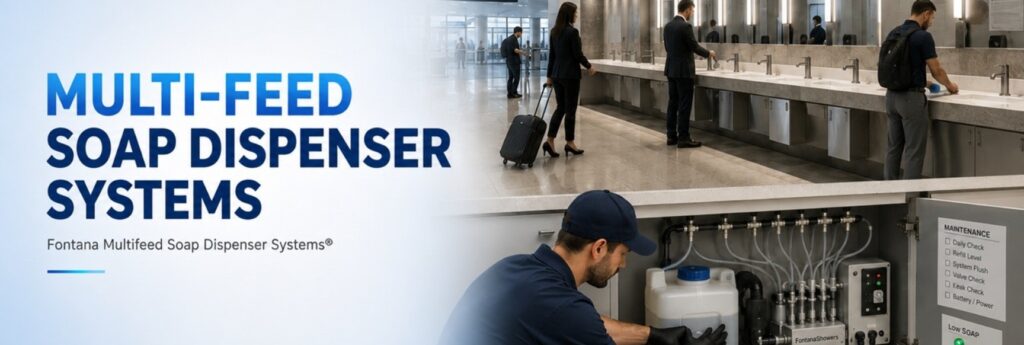
Individual reservoirs distribute soap storage across many dispensing positions. A central-feed system consolidates that storage into fewer service locations.
Fontana’s current MultiFeed page describes the system as connecting multiple automatic dispensers to a central soap reservoir specifically to reduce individual refill activity and maintenance effort.
But Centralization Creates a Different Cost: Shared-System Risk
Central systems can improve maintenance efficiency, but the project team should also evaluate the consequence of a central pump, reservoir, controller or distribution problem.
Large facilities can instead evaluate multiple service zones so that a single maintenance event does not affect every handwashing station.
The final zoning strategy must follow the capabilities and limitations of the selected manufacturer-approved system.
1-Sink Project: Cost Model
For one dispensing position, simplicity usually matters more than centralization.
| Cost Item | Project Input |
|---|---|
| Automatic soap dispenser | $________ |
| Reservoir / soap container | $________ |
| Power components | $________ |
| Installation labor | $________ |
| Commissioning | $________ |
| Initial installed cost | $________ |
| Annual soap | $________ |
| Annual refill labor | $________ |
| Annual maintenance | $________ |
| 10-year TCO | $________ |
6-Sink Commercial Restroom: Cost Model
Six grouped sinks create the first major architecture decision: six independent soap supplies or an approved centralized system.
| Cost Factor | 6 Individual Reservoirs | Central Feed |
|---|---|---|
| 6 dispenser heads | $________ | $________ |
| Soap storage | 6 reservoirs / refills | Central reservoir |
| Pump / manifold | Individual | $________ |
| Tubing | Limited | $________ |
| Installation | $________ | $________ |
| Annual refill labor | $________ | $________ |
| Annual soap | $________ | $________ |
| 10-year maintenance | $________ | $________ |
| 10-year TCO | $________ | $________ |
12-Sink Project: Where Lifecycle Economics Become Important
At twelve dispensing positions, the purchasing team should stop thinking only in terms of fixture price.
24-Sink Facility: Think in Service Zones
Twenty-four dispensing positions may represent a stadium restroom bank, airport concourse, convention facility, university building or multiple commercial restrooms.
At this scale, the engineering team should evaluate:

10-Year TCO Formula
Initial Equipment
+ Installation
\+ 10-Year Soap
+ Refill Labor
+ Power
+ Preventive Maintenance
+ Repairs
+ Replacement Parts
+ Inventory
+ Waste Handling
For a large commercial project, the lowest initial purchase price can therefore be different from the lowest lifecycle cost.
10-Year Cost per Dispensing Position
10-Year System TCO ÷ Number of Dispensing Positions
10-Year Cost per 1,000 Handwashes
10-Year TCO ÷ 10-Year Activations × 1,000
These two metrics make comparisons between architectures far more useful than comparing fixture purchase price alone.
Example: Why Soap Dose Matters More as the Project Gets Larger
Assume 24 dispensers average 300 activations each per day:
| Dose | Daily Soap | Annual Soap | 10-Year Volume |
|---|---|---|---|
| 0.5 mL | 3.6 L | 1,314 L | 13,140 L |
| 0.8 mL | 5.76 L | 2,102.4 L | 21,024 L |
| 1.0 mL | 7.2 L | 2,628 L | 26,280 L |
| 1.2 mL | 8.64 L | 3,153.6 L | 31,536 L |
Reservoir Cost Is Really a Labor Decision
Fontana’s current high-traffic reservoir guidance recommends sizing from actual activations, soap dose, days between service and operating reserve.
The guidance identifies approximately 1.2–1.5 liters as a practical baseline for many individual high-traffic dispensers and larger capacities or central systems where demand and maintenance intervals require them.
Commercial Reservoir Capacity GuideInspection Frequency Is Not the Same as Refill Frequency
A large reservoir may reduce refilling, but commercial equipment should still be inspected during scheduled cleaning rounds.
Fontana’s current refill guidance recommends checking high-traffic dispensers frequently and maintaining an operating reserve rather than deliberately running reservoirs empty.
Accessibility and Sink Coordination
Automatic soap dispensing does not eliminate the need to coordinate the complete accessible handwashing station.
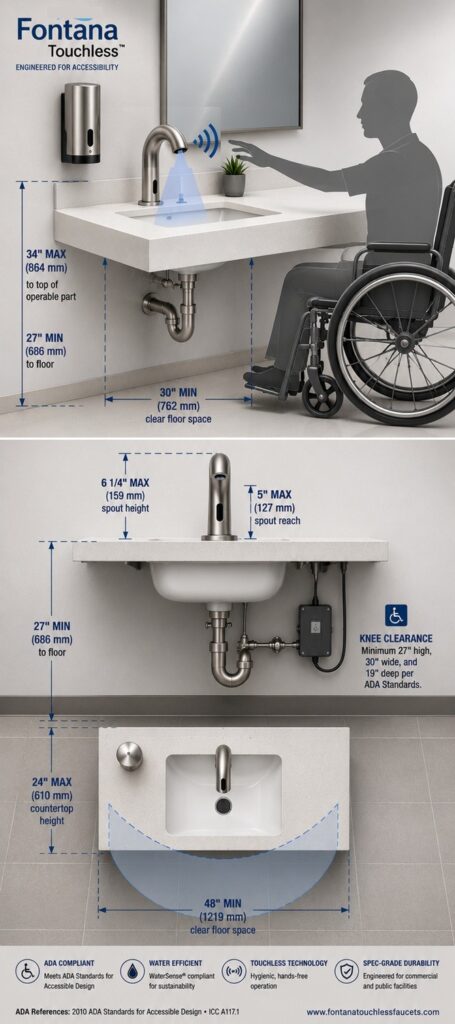
The U.S. Department of Justice ADA Standards include technical requirements for accessible sinks and lavatories, including clear floor space, knee and toe clearance, sink height, faucets, and exposed pipes and surfaces.
Architects should coordinate the soap dispenser with those requirements and with applicable local accessibility provisions.
2010 ADA StandardsDo Not Incorrectly Claim WaterSense Certification for Public Lavatory Faucets
This distinction matters when an integrated faucet-and-soap system is being specified.
EPA states that WaterSense currently has labeling criteria for private lavatory faucets, but not for public lavatory faucets or metering faucets. EPA notes that public lavatory faucets typically used in non-private toilet facilities should generally have a flow rate of 0.5 gallons per minute or less to be considered efficient and meet applicable plumbing-code requirements.
Project Budget Worksheet: 1 vs 6 vs 12 vs 24 Positions
| Cost Input | 1 Position | 6 Positions | 12 Positions | 24 Positions |
|---|---|---|---|---|
| Dispenser equipment | $_____ | $_____ | $_____ | $_____ |
| Reservoir / MultiFeed | $_____ | $_____ | $_____ | $_____ |
| Power | $_____ | $_____ | $_____ | $_____ |
| Installation | $_____ | $_____ | $_____ | $_____ |
| Commissioning | $_____ | $_____ | $_____ | $_____ |
| Initial installed cost | $_____ | $_____ | $_____ | $_____ |
| Annual soap | $_____ | $_____ | $_____ | $_____ |
| Annual refill labor | $_____ | $_____ | $_____ | $_____ |
| Annual PM | $_____ | $_____ | $_____ | $_____ |
| Annual repairs | $_____ | $_____ | $_____ | $_____ |
| Annual power / batteries | $_____ | $_____ | $_____ | $_____ |
| 10-year TCO | $_____ | $_____ | $_____ | $_____ |
| TCO / position | $_____ | $_____ | $_____ | $_____ |
Verified Fontana Commercial Project Resources
Centralized soap supply for multiple automatic dispensing positions in high-traffic facilities.
MultiFeed SystemsCalculate reservoir volume from actual traffic, dose, service interval and operating reserve.
Capacity GuideCalculate realistic refill intervals and maintenance inspection schedules.
Refill GuideFontana project resources for commercial architectural and specification teams.
AEC ResourcesIndependent Commercial Restroom References
Official accessible-design requirements relevant to commercial sinks, lavatories and controls.
ADA StandardsBest-management practices for water management, operations, maintenance and project payback.
Commercial BMPsOfficial distinction between private WaterSense-labeled lavatory faucets and public commercial lavatory faucets.
Faucet GuidanceCommercial Automatic Soap Dispenser Cost FAQ
How much does a commercial automatic soap dispenser cost?
The correct project cost includes the dispenser, reservoir or refill system, power components, mounting accessories, installation and commissioning. Commercial product prices vary significantly by architecture, finish, capacity, quantity and project requirements.
How much does a six-sink automatic soap system cost?
Multiply the quoted equipment cost by six and then add reservoirs or central-feed components, installation, power and commissioning. For grouped basins, compare independent reservoirs against a manufacturer-approved centralized architecture.
Is MultiFeed cheaper than individual dispensers?
Not automatically. MultiFeed may reduce refill labor and consolidate soap storage, but it can require central equipment, tubing and additional installation. Compare total lifecycle cost.
How much soap does a commercial restroom use annually?
Multiply daily soap activations by the actual dose and annual operating days. For example, 5,000 daily activations at 0.8 mL use approximately 1,460 liters per year.
What is the biggest 10-year cost?
It depends on the project. In high-volume facilities, soap and labor can accumulate substantially over time, making initial fixture price only one part of the ownership cost.
Should a 24-sink facility use one central soap tank?
Not necessarily. Large facilities should evaluate manufacturer-approved capacity, maximum supported dispensers, tubing limitations, redundancy and service zoning rather than creating an excessive single point of failure.
Does a larger reservoir reduce cost?
It can reduce refill frequency, but oversized storage can consume service space and does not eliminate inspection or maintenance. Reservoir capacity should be calculated from actual demand.
Should architects specify soap dose?
The project team should at minimum document and verify the selected dispenser’s delivered-dose range because dose materially affects reservoir sizing, consumable cost and refill frequency.
Final Recommendation: Buy the System, Not Just the Dispenser
For one sink, equipment and installation usually dominate the purchasing decision.
At six sinks, reservoir strategy and refill labor become more important.
At twelve sinks, soap consumption, maintenance workflow and central-feed architecture can materially affect lifecycle economics.
At twenty-four positions and above, project teams should think in terms of commercial systems, service zones, redundancy, peak demand, spare parts, preventive maintenance and 10-year ownership cost.
That calculation forces equipment cost, soap consumption, refill labor, maintenance and system reliability into the same financial model.
Commonly Asked Questions
CFD, Soap Rheology & Distribution-Network Modeling
AEC guidance for computational fluid dynamics, non-Newtonian soap behavior, rheological modeling, hydraulic-design accuracy and engineering correlations for centralized commercial soap networks.
Can computational fluid dynamics accurately model commercial liquid soap inside multi-feed tubing?
Yes; CFD can model soap flow when viscosity, rheology, tubing geometry, boundary conditions, and pump behavior are accurately characterized.
Which rheological model best represents commercial hand soap in distribution networks?
For many soaps, a shear-thinning model such as Carreau or Cross often represents flow better than constant-viscosity assumptions.
Does hand soap behave as a Newtonian, shear-thinning, or yield-stress fluid inside small tubing?
Many hand soaps are shear-thinning; some exhibit yield stress, while others approximate Newtonian behavior over limited operating ranges.
How large is the error when conventional water-flow equations are used to design soap networks?
Errors can be substantial when water equations ignore higher viscosity, shear-thinning behavior, entrance losses, and pump-specific flow characteristics.
Could a universal engineering equation be developed specifically for centralized soap distribution?
Potentially; a universal correlation would require validated relationships among rheology, pressure, tubing geometry, temperature, pump type, and dose timing.

