


2026 AEC / MEP Commercial Restroom Specification Guide
Commercial Specification
Specifying a commercial automatic soap dispenser requires more than selecting a touchless fixture from a catalog. Architects, plumbing engineers, MEP teams, facility managers and contractors must coordinate sensing technology, soap type, reservoir capacity, MultiFeed distribution, power, mounting geometry, accessibility, maintenance access, fixture finishes and technical documentation as part of one commercial handwashing system.
2026 Commercial Soap Consumption & Dose Engineering Calculator
Automatic Soap Dispenser Dose Calculator: 0.3 mL vs 0.5 mL vs 0.8 mL vs 1 mL vs 1.5 mL vs 2 mL
How much difference can a few tenths of a milliliter make in a commercial restroom? Across airports, stadiums, hospitals, universities, office towers and other high-traffic facilities, a small change in soap delivered per activation can translate into hundreds or thousands of liters of annual consumption. This guide calculates reservoir life, soap usage, cost per 1,000 activations and the impact of dose across one million automatic soap-dispenser cycles.
Soap Dose Is One of the Most Important Numbers in the System
Commercial buyers often focus on reservoir capacity while overlooking the quantity dispensed during each sensor activation.
But reservoir size alone cannot tell the facility how long its soap will last.
Soap Consumption
Number of Activations × Soap Dose per Activation
A 1-liter reservoir at 0.5 mL delivers twice as many theoretical activations as the same reservoir at 1.0 mL.
Real Fontana Commercial Dose Examples
Current Fontana commercial product pages demonstrate why one universal automatic-soap dose should never be assumed.
Fontana Aquanix™ Commercial Touchless Set
Current product documentation lists:
- Standard liquid soap
- 800 mL bottle
- Optional 1-gallon container
- 6V peristaltic soap pump
- Adjustable soap amount: 0.5–1.5 mL per use
Fontana Commercial Wall-Mount Platform
Current Fontana documentation for one wall-mounted commercial system states a precision dispensing range of approximately 0.3–0.8 mL per cycle.
Specification rule:
Never copy the dose from one Fontana model into another product specification. Output is model-, pump- and configuration-specific.
Interactive Commercial Soap Dose Calculator
Enter the project’s actual activation volume, dispenser dose, soap price and reservoir capacity.
What Happens Across 1 Million Automatic Soap Activations?
| Dose per Activation | Soap Used per 1 Million Activations | Difference vs 0.3 mL |
|---|---|---|
| 0.3 mL | 300 L | Baseline |
| 0.5 mL | 500 L | +200 L |
| 0.8 mL | 800 L | +500 L |
| 1.0 mL | 1,000 L | +700 L |
| 1.5 mL | 1,500 L | +1,200 L |
| 2.0 mL | 2,000 L | +1,700 L |
At one million activations, increasing dose from 0.5 mL to 1.0 mL requires an additional 500 liters of soap.
Soap Cost Across 1 Million Activations
To make the financial effect visible, assume an illustrative bulk-soap price of $4 per liter.
| Dose | Soap Volume | Illustrative Cost at $4/L |
|---|---|---|
| 0.3 mL | 300 L | $1,200 |
| 0.5 mL | 500 L | $2,000 |
| 0.8 mL | 800 L | $3,200 |
| 1.0 mL | 1,000 L | $4,000 |
| 1.5 mL | 1,500 L | $6,000 |
| 2.0 mL | 2,000 L | $8,000 |
These dollar values are illustrative only. Insert the facility’s negotiated soap cost for a real procurement analysis.
Cost per 1,000 Automatic Soap Activations
Cost per 1,000 Activations
Dose in mL × Soap Cost per Liter
At an illustrative $4 per liter:
| Dose | Soap / 1,000 Activations | Cost / 1,000 Activations |
|---|---|---|
| 0.3 mL | 0.30 L | $1.20 |
| 0.5 mL | 0.50 L | $2.00 |
| 0.8 mL | 0.80 L | $3.20 |
| 1.0 mL | 1.00 L | $4.00 |
| 1.5 mL | 1.50 L | $6.00 |
| 2.0 mL | 2.00 L | $8.00 |
How Dose Changes Reservoir Life
Consider a 1.5-liter dispenser with 80% planned working capacity.
Usable capacity = approximately 1,200 mL.
| Dose | Planned Activations Before Refill | At 500 Activations / Day |
|---|---|---|
| 0.3 mL | 4,000 | 8.0 days |
| 0.5 mL | 2,400 | 4.8 days |
| 0.8 mL | 1,500 | 3.0 days |
| 1.0 mL | 1,200 | 2.4 days |
| 1.5 mL | 800 | 1.6 days |
| 2.0 mL | 600 | 1.2 days |
Fontana’s current commercial refill guide uses the same underlying methodology: daily consumption equals activations multiplied by dose, and planning should use only approximately 75–80% of nominal reservoir capacity.
10-Liter MultiFeed Example: Dose Changes Everything
Assume a nominal 10-liter reservoir and preserve 20% as operating reserve. Working soap capacity is approximately 8 liters.
| Dose | Working Activations | At 2,500 Activations/Day | At 5,000 Activations/Day |
|---|---|---|---|
| 0.3 mL | ≈26,667 | ≈10.7 days | ≈5.3 days |
| 0.5 mL | 16,000 | 6.4 days | 3.2 days |
| 0.8 mL | 10,000 | 4.0 days | 2.0 days |
| 1.0 mL | 8,000 | 3.2 days | 1.6 days |
| 1.5 mL | ≈5,333 | ≈2.1 days | ≈1.1 days |
| 2.0 mL | 4,000 | 1.6 days | 0.8 day |
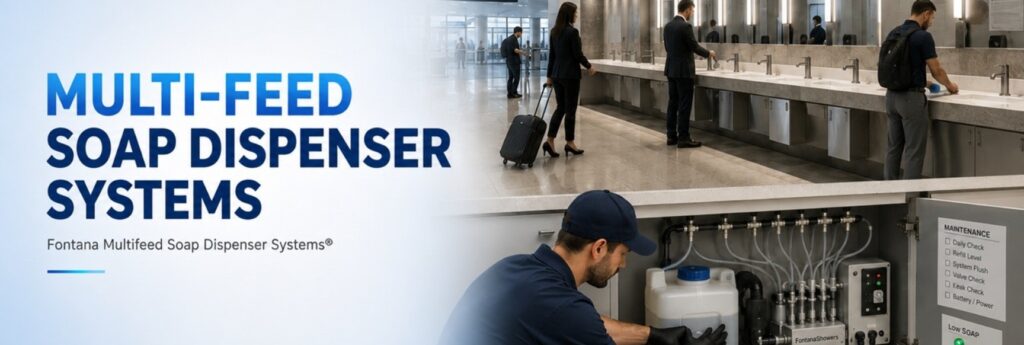
Do not size MultiFeed from reservoir capacity alone.
Fontana’s current engineering guidance says central reservoir selection must also reflect traffic, activation frequency, operating hours, refill staffing, service interval, storage space and contingency capacity.
Annual Soap Consumption by Daily Traffic
Assuming 365 operating days:
| Daily Activations | 0.3 mL | 0.5 mL | 0.8 mL | 1.0 mL | 1.5 mL | 2.0 mL |
|---|---|---|---|---|---|---|
| 500/day | 54.75 L | 91.25 L | 146 L | 182.5 L | 273.75 L | 365 L |
| 1,000/day | 109.5 L | 182.5 L | 292 L | 365 L | 547.5 L | 730 L |
| 2,500/day | 273.75 L | 456.25 L | 730 L | 912.5 L | 1,368.75 L | 1,825 L |
| 5,000/day | 547.5 L | 912.5 L | 1,460 L | 1,825 L | 2,737.5 L | 3,650 L |
| 10,000/day | 1,095 L | 1,825 L | 2,920 L | 3,650 L | 5,475 L | 7,300 L |
24-Dispenser Example: Small Dose Changes Become Huge
Assume 24 dispensers each average 300 activations per day.
Total Daily Activations
24 × 300 = 7,200 activations/day
| Dose | Daily Soap | Annual Soap | 10-Year Soap Volume |
|---|---|---|---|
| 0.3 mL | 2.16 L | 788.4 L | 7,884 L |
| 0.5 mL | 3.60 L | 1,314 L | 13,140 L |
| 0.8 mL | 5.76 L | 2,102.4 L | 21,024 L |
| 1.0 mL | 7.20 L | 2,628 L | 26,280 L |
| 1.5 mL | 10.80 L | 3,942 L | 39,420 L |
| 2.0 mL | 14.40 L | 5,256 L | 52,560 L |
At this illustrative traffic level, the 10-year mathematical difference between 0.5 mL and 1.0 mL is 13,140 liters of soap.
Why the Lowest Dose Is Not Automatically the Best Dose
Reducing soap output can reduce consumption, but an excessively low dose can create its own problem: users may activate the dispenser again.
Efficient Dose
Provides sufficient soap for the intended handwashing event without unnecessary excess.
Under-Dose
Can encourage users to trigger the dispenser two or three times, undermining the apparent savings.
Effective Soap per Handwashing Event
Dose per Activation × Average Activations per User
For example, a 0.5 mL setting used twice produces the same 1.0 mL total soap volume as a single 1.0 mL activation.
Measure Activations per User
| Programmed Dose | Average Activations/User | Effective Soap per Handwashing Event |
|---|---|---|
| 0.3 mL | 1.0 | 0.30 mL |
| 0.3 mL | 2.0 | 0.60 mL |
| 0.5 mL | 1.0 | 0.50 mL |
| 0.5 mL | 2.0 | 1.00 mL |
| 0.8 mL | 1.25 | 1.00 mL |
| 1.0 mL | 1.0 | 1.00 mL |
Facility optimization requires both sensor data and human behavior.
The best dose is the setting that delivers adequate soap with minimal repeat activation—not merely the smallest number available on the controller.
Soap Viscosity Can Affect Delivered Volume
Commercial automatic dispensers are pump systems. Soap formulation matters.
Fontana’s current Aquanix and St. Gallen commercial specifications both document standard liquid soap, peristaltic pump architecture and adjustable 0.5–1.5 mL output.
How to Commission Soap Dose on a Commercial Project
Do not optimize only for minimum soap volume.
The goal is predictable, adequate delivery with minimal waste and repeat activations.
Where Dose Optimization Has the Greatest Financial Impact
| Facility | Why Dose Matters |
|---|---|
| Airport | High annual activation volume magnifies small changes in delivered soap. |
| Stadium / Arena | Extreme peak usage can rapidly consume central reservoirs. |
| Hospital Public Restrooms | High availability requirements make reliable dose and reservoir planning important. |
| University | Large dispenser fleets can turn small per-cycle changes into large annual volumes. |
| Office Tower | Predictable traffic makes before/after dose optimization easier to measure. |
| Convention Center | Event-period volume can create rapid soap depletion. |
| Luxury Hospitality | Efficiency must remain balanced with user experience. |
What Architects & MEP Engineers Should Specify
Dose Optimization ROI
Annual Soap Savings
Old Annual Volume − New Annual Volume
Annual Dollar Savings
Annual Liters Saved × Soap Cost per Liter
Optimization Payback
Cost of Adjustment / Commissioning ÷ Annual Savings
Where adjustment can be performed during normal commissioning or preventive maintenance, the incremental implementation cost may be relatively small.
Commercial Automatic Soap Dispenser Research Series
Commercial Refill Frequency
Calculate refill intervals using dose, activations, usable capacity and reserve.
High-Traffic Reservoir Capacity
Determine appropriate commercial reservoir size from actual daily consumption.
Fontana MultiFeed™ Engineering
Central reservoir, pump, manifold, tubing and multi-dispenser engineering.
Adjustable 0.5–1.5 mL Commercial System
Current Fontana Aquanix™ touchless faucet and automatic soap dispenser platform.
Commercial Wall-Mount Dispenser
Current Fontana platform documenting precision controlled 0.3–0.8 mL dispensing.
St. Gallen Commercial Dispenser
Current commercial deck-mounted model with peristaltic pump and adjustable output.
Automatic Soap Dispenser Dose FAQ
What is a normal automatic soap dispenser dose?
There is no universal commercial dose. Current Fontana models demonstrate ranges including approximately 0.3–0.8 mL on one platform and adjustable 0.5–1.5 mL on several other commercial systems. Always use the specification for the exact model.
How much soap does 0.5 mL use over one million activations?
Exactly 500 liters mathematically, before considering priming, leakage, maintenance losses or other real-world factors.
How much soap does a 1 mL dose use over one million activations?
One million activations at 1 mL consume 1,000 liters of soap.
What is the difference between 0.5 and 0.8 mL?
Across one million activations, 0.8 mL consumes 800 liters while 0.5 mL consumes 500 liters—a theoretical difference of 300 liters.
Does lowering the dose always save soap?
Not necessarily. If users repeatedly activate an under-dosed dispenser, the effective amount of soap used during each handwashing event can increase.
How does dose affect reservoir life?
Reservoir life is inversely related to dose. Doubling soap delivered per activation approximately halves the theoretical number of cycles available from the same usable reservoir volume.
Does Fontana offer adjustable soap dose?
Yes. Several current Fontana commercial automatic dispenser models document adjustable output, including models listing approximately 0.5–1.5 mL per use.
Should automatic soap dose be commissioned?
For substantial commercial projects, measuring actual output after installation is useful because the real delivered volume affects reservoir sizing, consumption and refill planning.
Does soap viscosity affect dose?
It can. Pump architecture, formulation and viscosity can influence real-world output. Use manufacturer-approved soap and verify operation after changing formulations.
What dose should architects specify?
Architects and engineers should avoid inventing a universal value. Specify the performance intent and verify that the selected product’s documented and commissioned dose supports the project’s soap-use, user-experience and maintenance requirements.
Final Recommendation: Optimize the Effective Dose, Not the Lowest Setting
Automatic soap dose is a small specification number with very large lifecycle consequences.
At one dispenser, the difference may look trivial.
Across twenty-four, fifty or hundreds of dispensing positions operating for years, a fraction of a milliliter can translate into thousands of liters of soap.
The most useful facility metric is not “mL per activation” by itself. It is effective soap volume per successful handwashing event.
Technical & Cost Disclosure:
All volume, cost and reservoir-duration calculations in this article are mathematical examples based on the stated inputs.
The 0.3, 0.5, 0.8, 1.0, 1.5 and 2.0 mL values are comparison points and should not be interpreted as universal settings for all automatic soap dispensers.
Current Fontana models have different documented dispensing ranges. Examples verified during preparation of this page include approximately 0.3–0.8 mL per cycle on one commercial wall-mounted platform and adjustable 0.5–1.5 mL on several commercial deck-mounted systems.
Actual output can be influenced by selected model, pump design, soap formulation, viscosity, controller setting, priming, nozzle condition and maintenance.
The lowest available dispenser setting is not necessarily the most economical effective setting if users compensate by triggering the dispenser repeatedly.
All internal links displayed in the research-resource section were verified before inclusion.
Questions About Our Services
Refill Identification, RFID & Soap Compatibility Control
AEC guidance for keyed refill connections, formulation identification, RFID-enabled replenishment, automatic pump configuration and incompatible-soap detection within centralized commercial soap systems.
What connector design would prevent personnel from adding the wrong soap formulation?
Keyed, non-interchangeable connectors can prevent wrong-soap loading by physically matching only approved refill containers and reservoir inlets.
Could keyed refill connectors create a universal standard for commercial soap systems?
Potentially; standardized keyed interfaces could reduce refill errors , but universal adoption would require industry-wide dimensional, compatibility, and labeling requirements.
Should soap reservoirs electronically identify the formulation loaded into them?
Yes; electronic formulation identification could support traceability, compatibility checks, maintenance records, and automatic configuration of dispensing parameters.
Could RFID-tagged soap containers automatically configure pump settings?
Yes; RFID-tagged containers could transmit soap identity and approved settings , allowing compatible controllers to configure pump parameters automatically.
Can a multi-feed controller detect that an incompatible soap has been loaded?
Potentially; conductivity, optical, RFID, or viscosity data could flag mismatches , but reliable detection requires validated formulation-specific baselines.

